 Translate

Contents
1. Chief Police Officer’s Foreword
AFP Professional Standards Framework and AFP Conduct Issues
ACT Policing Complaint Statistics
Average Full-Time Equivalent and Headcount
ACT Policing Workforce Composition Headcount
Average Length of Service by Gender
Acknowledgement of Country
The Australian Federal Police acknowledges the traditional owners and custodians of country throughout Australia and acknowledges their continuing connection to land, sea and community.
We pay our respects to the people, the cultures and the Elders past, present and emerging.
1. Chief Police Officer’s Foreword
- Operational overview
- Investing in our workforce
- Domestic and Family Violence Investigation Unit
- Engagement with First Nations communities
- Expansion of online reporting
- Operation Archon
- Combatting hate crime
It is an honour to present the ACT Policing Annual Report for 2024–25 as the Chief Police Officer for the ACT.
The past 12 months have been incredibly busy, yet a year of strong performance for ACT Policing. We remain committed to delivering a professional, effective and community-focused policing service to the people of the ACT. This dedication is supported by our diverse and inclusive workforce, who continue to apply intelligence-led, evidence-based and innovative strategies to reduce crime, enhance safety, and engage meaningfully with our community.
Under the ACT Policing Strategy 2024–27 the ACT Policing pillars focus on highly visible, responsive and proactive policing, a healthy, professional and skilled workforce, collaborating with our partners and enhancing our capabilities.
As the Chief Police Officer for the ACT my highest priority is continuing to target resources where they are most effective, conduct focused crime prevention activities and work across the broader justice system with our government and non-government partners to address the root causes of crime. This is the cornerstone for the delivery of the ACT Policing mission of ‘Policing for a safer community’.
Operational overview
Canberra remains one of the safest cities in Australia and ACT Policing is committed to ensuring that continues.
In 2024–25 ACT Policing attended over 51,000 incidents, averaging approximately 142 incidents per day. Community satisfaction with police services and confidence in police remains high continuing the trend of a reduction of reportable offences over the past five years. We are dedicated in our mission to reduce crime and increase public safety, and have had positive results in 2024–25.
ACT Policing continues to respond to the challenges of illicit drug use, mental health incidents and ongoing domestic family and domestic violence cases. Tackling these issues requires a multi-agency response, and the community can be assured that collaboration with our partners remains a cornerstone of ACT Policing’s Strategic Direction.
In 2024–25 our Drugs and Organised Crime Team made 866 illicit drug seizures, preventing over 1,200 kilograms of harmful drugs from entering the community. This has significantly disrupted organised crime networks and their ability to profit from drug sales in the ACT and beyond.
Despite the tragic loss of eight lives on Canberra roads in 2024–25, our proactive road safety initiatives have made a significant impact. More than 100,000 drink and drug driving tests were conducted, resulting in over 950 charges. Legislative changes related to immediate licence suspensions, vehicle seizures and expanded roadside drug testing are being actively utilised to enhance road safety.
ACT Policing continues to work collaboratively with partner agencies to target Outlaw Motorcycle Gangs and other organised crime groups. Our targeted operational plans have addressed community safety concerns.
The North District Community Engagement Strategy has received positive feedback from the public, thanks to proactive high-visibility patrolling, road policing operations and tailored engagement with residents and community groups.
Operation City Safe, conducted in July 2024, successfully addressed criminal and anti-social behaviour in the City and Braddon precincts, resulting in 45 arrests and 59 cautions or move-on notices. These efforts are guided by an intelligence-led strategy, ensuring resources are directed to areas of greatest need based on real-time data and analysis.
Investing in our workforce
A healthy, professional and skilled workforce is crucial to our success. Our headcount and full-time equivalent numbers continue to grow, meeting the ACT Government’s commitment to strengthen ACT Policing and ensure we can respond to the needs of a growing city.
On 19 June 2023 the ACT Chief Minister and Minister for Police and Crime Prevention announced a significant funding increase for ACT Policing, with an extra $107 million to fund 126 additional positions over the next five years. This commitment was further extended in the lead-up to the October 2024 election, with plans to recruit and train an additional 24 police officers, boosting our total resourcing increase to 150 officers by 2029. We are well on track to meet this commitment.
In the 2024–25 financial year 89 recruits commenced training, and our sworn headcount increased by 3.37 per cent. We are also proud to have the second-highest percentage of female staff in the country among policing organisations.
Domestic and Family Violence Investigation Unit
Since its launch in mid-2024 the Domestic and Family Violence Investigation Unit (DFVIU) has carried out holistic investigations and case management of high-risk domestic and family violence (DFV) matters. This approach aims to reduce the risk and incidence of DFV homicide in the ACT and repeat calls for service, while ensuring a consistent response to DFV incidents.
Our holistic DFV investigations model considers individual incidents in the context of the broader DFV relationship, providing a single point of contact for victims. This model is based on extensive analysis and consultation with external partners, including the Domestic Violence Crisis Service (DVCS), Family Violence Safety Action Program (FVSAP) and academic experts in DFV.
Ongoing enhancements include a revised DFV training continuum developed in partnership with the ACT Government’s Domestic, Family and Sexual Violence Office, which is also providing funding for specialist coercive control training.
Sadly there were 4,478 domestic and family violence-related incidents reported to ACT Policing in 2024–25, averaging 12 incidents per day. During this period the DFVIU laid 163 charges related to DFV incidents, with 72 of these charges leading to arrests.
Engagement with First Nations communities
Strengthening the connection between law enforcement and our First Nations communities and fostering a relationship based on mutual respect and trust, remains a key priority for ACT Policing.
As I outlined in my opening statement in the 2023–2028 ACT Policing Strategy for Engagement with First Nations People and Communities, ACT Policing acknowledges the long history of poor engagement between First Nations people and police agencies, including our own. ACT Policing is committed to listening to hard truths and recognises a shared responsibility and a unique opportunity to work with our partners and stakeholders to ensure all First Nations people and communities in the ACT feel safe and supported.
Our comprehensive Policing Strategy for Engagement with First Nations People and Communities 2023–2028, developed in close consultation with the ACT Aboriginal and Torres Strait Islander community, is now well in place. It encompasses 28 targeted actions for change and outlines how ACT Policing engages, consults and builds positive relationships with our stakeholder
communities. ACT Policing recognises that there is a long but shared road ahead towards building a strong, positive and trusting relationship between ACT Policing and First Nations people and communities.
The reinvigorated Chief Police Officer’s Advisory Board provides an avenue for direct community feedback and considers strategic issues regarding our engagement with First Nations peoples in the ACT. We continue to implement recommendations from the Ombudsman’s Own Motion Investigation, with five recommendations fully implemented and four partially implemented.
Our First Nations Cultural Literacy Training Program has been positively received, encouraging our members to critically reflect on their cultural assumptions, biases and stereotypes. This mandatory training has been delivered to over 750 ACT Policing members and now includes yarning circles for direct engagement with local First Nations Elders and community representatives.
Expansion of online reporting
To foster community engagement and encourage crime reporting, ACT Policing continues to explore innovative solutions and enhanced digital engagement. Our online reporting portal was enhanced in 2024–25 to offer more choice and convenience for the Canberra community. The portal now includes reporting of minor theft, retail theft and lost property matters online, demonstrating a growing need for multiple reporting options.
The online reporting portal has provided an efficient mechanism for the community to work in partnership with ACT Policing, particularly in keeping our roads safe. Over the last year 1,816 online Dangerous Driving reports were received, resulting in 1,121 Traffic Infringement Notices and 249 Cautions being issued.
Ongoing development of the portal is driven by community feedback and the needs of ACT Policing and our partners. Our focus moving forward will be a secure partner agency portal for streamlined, secure interagency information sharing.
Operation Archon
I commend the work of everyone involved in facilitating the Guest of Government visit of His Majesty King Charles III and Her Majesty Queen Camilla. The success of this visit, involving complex logistics, security, and protocol, relied on the professionalism and expertise of ACT Policing members, particularly those in Emergency Management and Planning.
Combatting hate crime
There is absolutely no place for anti-semitism in Canberra. This inclusive and welcoming city must remain that way. While we have seen a significant increase in hate crimes, particularly anti-semitic incidents across Australia, we have not experienced the same number of incidents in the ACT. However, we take this issue seriously and will respond quickly and appropriately.
ACT Policing has conducted high-visibility patrols around Jewish Centres and other communities to ensure safety and reassurance. Operation Balranald, established in December 2024, coordinates responses to anti-semitic incidents in the ACT. We also engage with AFP Special Operation Avalite to investigate anti-semitic incidents.
Regular communication with representatives of our Jewish community ensures their concerns are heard, and we provide the necessary assistance to ensure everyone feels safe.
I am proud of the hard work, dedication, and resilience shown by all members of ACT Policing, including our corporate staff. Each member contributes to our success, and I am confident that ACT Policing will remain responsive to any challenges, continually exploring ways to innovate and improve to be a leading policing jurisdiction in Australia.

Deputy Commissioner Scott Lee APM
Chief Police Officer for the ACT
2. Ministerial Direction
This Ministerial Direction is issued under section 7 of the Policing Arrangement between the Ministers of the Commonwealth and Australian Capital Territory (ACT) Governments and outlines the ACT Government’s priorities and expectations for the AFP and more specifically the Chief Police Officer (CPO).
This Direction is to be read in conjunction with the 2022–26 Purchase Agreement between the ACT Minister for Police and Emergency Services, the AFP Commissioner and the CPO.
This Direction supersedes and revokes the Direction issued on 28 October 2019.
The ACT Government is committed to the community’s wellbeing including ensuring Canberrans are, and feel, safe and secure around their homes, community and online. ACT Policing plays a key role in supporting the ACT Government’s commitment to the Safety domain in the Wellbeing Framework. My expectation is that ACT Policing delivers all functions under the Policing Arrangement 2017 and 2022–26 Purchase Agreement and will focus its activities to keep the peace and preserve public safety within the ACT.
In the current environment, the expected focus areas for ACT Policing are:
Transition to the Police Services Model
- Continue transitioning to a more prevention and community-focused Police Services Model (PSM) that better supports ACT Government and community priorities. The PSM will be: intelligence led, evidence based, agile and mobile, and systemic.
- Enhance digital engagement to ensure ACT Policing continues to evolve in line with community expectations.
Reducing the overrepresentation of Aboriginal and Torres Strait Islander people
- As part of the ACT Government’s justice reinvestment strategy and the focus on pillar one of the Reducing Recidivism in the ACT by 25% by 2025 (RR25by25) Plan, in recognition of the disadvantages and challenges facing the ACT’s First Nations community and national work to close the gap on this disadvantage, work with the ACT Government to support the community to help reduce overrepresentation in the criminal justice system.
- Design and implement an ACT Policing engagement framework in consultation with the ACT’s First Nations community. This includes implementing agreed recommendations from the Ombudsman report on ACT Policing’s administrative framework for engagement with the ACT Aboriginal and Torres Strait Islander community that relate to Aboriginal and Torres Strait Islander peoples.
Implement effective sexual assault prevention and responses
- Focus on the priority of effectively responding to sexual violence against children and adults as a strategic crime type. Work together with the Coordinator-General for Family Safety to implement the ACT Government’s response to the SAPR Steering Committee’s recommendations in the Listen, Take Action to Prevent, Believe and Heal report.
- Continue to review and improve ACT Policing operations’ response to sexual violence where care of the victim survivor is the core consideration.
Raising the age of minimum criminal responsibility
- Support the ACT Government’s priority reform to raise the Minimum Age of Criminal Responsibility (MACR) in the Territory. Continue engagement with key ACT Government directorates to identify areas of consideration in supporting the transition to these arrangements.
Combat dangerous driving
- Work with key areas of ACT Government to combat dangerous driving in both prevention and post-incident response.
- Take action to improve road safety, with emphasis on reducing road trauma experienced by vulnerable road users and combating anti-social and dangerous behaviours including speeding and driving while impaired or distracted.
Countering terrorism and violent extremism
- Continue to counter the threat of terrorism and violent extremism by strengthening the safety of the ACT’s public places in line with national strategies and best practice; and developing a fixated threat capability to meet the government’s obligations under the October 2017 Council of Australian Governments agreement.
In addition to a focus on these specific priority areas, it is my expectation that ACT Policing will continue to provide a professional, effective and efficient, policing service to the ACT community. This should be achieved through evidence-based and innovative strategies to meet the outcomes of the 2022–26 Purchase Agreement to reduce crime, increase public safety and engage with community and partners locally and nationally.
In achieving this, I expect ACT Policing to:
- Remain adaptive to the changing environment
- Continue to work with ACT Government and the community to build understanding of the resource pressures and impacts on community policing in responding to, and building permanent capabilities to address, significant natural disasters, pandemics and resultant social political and protest activity.
- Collaborate effectively with ACT Government, its agencies and stakeholders
- Being transparent and responsive, and actively engage with partner agencies on holistic approaches to complex social issues in support of the ACT Government’s policy agenda.
- Maintain an efficient, effective workforce
- Maintain a diverse and inclusive workforce that is committed to the wellbeing and health of its people so that it can continue to deliver a professional, innovative and effective policing service in a dynamic environment for the ACT community.
I note that Clauses 3 and 6 of the 2022–26 Purchase Agreement introduce a new requirement for ACT Policing to publish an annual CPO Statement of Intent (SOI). I look forward to receiving the strategies and plans that ACT Policing will put in place to address the ACT Government’s key priorities and this Ministerial Direction, and ACT Policing’s report on progress and outcomes against the SOI in the ACT Policing Annual Report.
Yours sincerely

Mick Gentleman MLA
Minister for Police and Emergency Services
28 September 2022
3. ACT Policing at a Glance
- Our Role
- Our Mission
- Our Intent
- Our Values
- Our Governance
- Our Budget
- Our Approach
- Our Performance
- Our Challenges
- Our People
- Our Future
- Our Community
Our Role
Through the 2022–26 Purchase Agreement with the AFP, ACT Policing is responsible for providing quality and effective policing services to the people of the ACT. We do this in partnership with the community and the ACT Government.
Our Mission
Our mission is Policing for a safer community.
Our Intent
Our pillars focus on highly visible, responsive and proactive policing, a healthy, professional and skilled workforce, collaborating with our partners and enhancing our capabilities.
ACT Policing continues to target resources where they are most effective, conduct focused crime prevention activities and work across the broader justice system with government and non- government partners to address the root causes of crime.
Our Values
We pride ourselves on being a values-driven organisation. Our core values of integrity, commitment, excellence, accountability, fairness, respect and trust represent our principles and standards — the values we uphold in performing our professional duties.
Our Governance
The key documents which govern the delivery of policing services to the ACT are the Policing Arrangement, 2022–26 Purchase Agreement and Ministerial Direction.
Policing Arrangement
The AFP is a statutory authority established by the Federal Parliament under the Australian Federal Police Act 1979. The AFP delivers policing services to the ACT as a separate outcome under a contractual arrangement between the Commonwealth Government and the ACT Government.
2022–26 Purchase Agreement
The Policing Arrangement provides for the negotiation of a 2022–26 Purchase Agreement between the AFP and the ACT Government. The agreement details the outcomes, outputs, performance measures, targets and facilities to be provided, the powers and obligations of the Minister for Police and Emergency Services and the Chief Police Officer (CPO), and associated administrative arrangements.
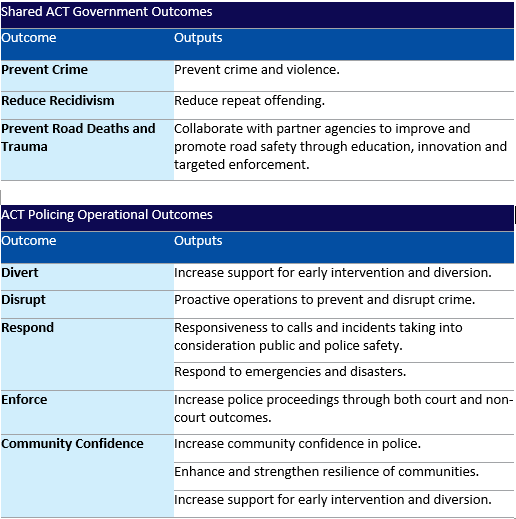
The main shared ACT Government Outcomes are:
- Prevent Crime – Prevent crime and violence.
- Reduce Recidivism – Reduce repeat offending.
- Prevent Road Deaths and Trauma – Collaborate with partner agencies to improve and promote road safety through education, innovation and targeted enforcement.
The main ACT Policing Operational Outcomes are:
- Divert – Increase support for early intervention and diversion.
- Disrupt – Conduct proactive operations to prevent and disrupt crime.
- Respond
- Improve responsiveness to calls and incidents taking into consideration public and police safety.
- Respond to emergencies and disasters.
- Enforce – Increase police proceedings through both court and non-court outcomes.
- Community Confidence
- Increase community confidence in police.
- Enhance and strengthen resilience of communities.
- Increase support for early intervention and diversion.
Alignment with ACT Government Priorities
The Policing Arrangement allows the Minister for Police and Emergency Services to provide general directions to ACT Policing (in writing) through a Ministerial Direction. The Ministerial Direction gives guidance on specific areas of focus relating to policy, priorities and goals for the provision of police services, without issuing directions on operational matters (see Chapter 2: Ministerial Direction).
Chief Police Officer’s Statement of Intent
ACT Policing publishes an annual CPO’s Statement of Intent (SOI), which sets out strategies and plans ACT Policing will implement to address the ACT Government’s key priorities and the Ministerial Direction. Achievements against the SOI will be recorded in subsequent Annual Reports.
Further details of the Policing Arrangement, the 2022–26 Purchase Agreement, the Ministerial Direction and the CPO’s SOI are available via ACT Policing’s website at: www.police.act.gov.au/about-us/government-directions.
Our Budget
Under the 2022–26 Purchase Agreement the funding provided by the ACT Government to the AFP for delivery of policing services in 2024–25 was $231.582 million.
The total price includes enabling costs and direct funding from the Justice and Community Safety Directorate (JACS) for crime prevention initiatives (see Chapter 8: Financials).
Our Approach
Our approach is underpinned by a series of strategies and initiatives that support the outcomes set out in the Performance Measure Framework:
Prevent Crime
Continued support of the ACT Property Crime Prevention Strategy, by promoting innovative and enduring crime prevention strategies and reducing the opportunities for crime to occur or reoccur.
Enhancing our response to, and the investigation of, offences by forging strong relationships with stakeholders to facilitate whole-of-government and cross-jurisdictional information sharing and collaboration.
Applying technology and forensic science capabilities, and effectively harnessing intelligence from a wide range of sources.
Providing effective and efficient support to the judicial process by maintaining a robust partnership with the ACT Director of Public Prosecutions and delivering high-standard briefs in a timely manner.
Facilitating a more efficient criminal justice system with an emphasis on timely preventive justice measures and judicial processes.
Reduce Recidivism
ACT Policing Intelligence continues to work with ACT Policing Proactive Intervention and Diversion Team in producing measurement and analytical tools for the purpose of understanding and treating recidivism and reducing impacts on the ACT community.
Prevent Road Deaths and Trauma
The ACT Government works closely with ACT Policing to develop and implement strategies to improve road safety and reduce anti-social and dangerous driving behaviours. These include joint education campaigns in line with the Road Safety Calendar, focused on improving road culture and driving behaviour. Additional initiatives include Operation TORIC and periodic high-visibility traffic enforcement operations on Canberra’s roads.
ACT Policing will continue to enforce the ACT’s laws and interact with those drivers that choose to do the wrong thing on Canberra’s roads.
Police continue to witness and prosecute dangerous driving incidents that include components of the ‘fatal five’ – impaired driving (alcohol and drug), failing to stop at intersections, excessive speeding, not wearing a seatbelt and driving while distracted – in addition to driving on the wrong side of the road and failing to stop for police.
Our Performance
ACT Policing’s performance is measured by the Performance Measure Framework, which incorporates two major outcomes and a series of strategies, initiatives and targets, as articulated in the 2022–26 Purchase Agreement.
The overarching budgetary outcome of the 2022–26 Purchase Agreement is to work in partnership with the community, to create a safer and more secure ACT through the provision of quality policing services. The Performance Measure Framework aims to enhance accountability for the delivery of services and provide clear links between ACT Policing’s outcomes, outputs, strategies and individual measures.
ACT Policing’s two sets of outcomes (Shared ACT Government and ACT Policing Operational Outcomes) are supported by 21 Performance Measures.
Performance Measures are described in detail in Chapter 4: Performance Analysis
Our Challenges
Major challenges and demands presented to ACT Policing during 2024–25 included:
- Officer safety: Officer safety is of the utmost importance. The ACT is continuing to see police officers and the community put at risk by recidivist dangerous drivers, including fail-to-stop offenders.
- Road safety and fatalities: The 2024–25 financial year saw eight fatalities on our roads in addition to other serious and life-changing injuries. Road safety is a priority for ACT Policing, resulting in efforts to significantly increase high-visibility operations in 2024–25.
- Increased demand for priority response: Over the last five years the number of Triple Zero (000) calls to the Police Operations Centre has increased. The centre now receives, on average, over 3,300 per month.
- Youth crime: ACT Policing continues to work collaboratively with key stakeholders as part of a multi-agency response to youth crime in the ACT, to identify those youths (of all ages) who need assistance and guidance, and divert them away from the criminal justice system.
- Combating recidivism: Recidivism continues to be an issue ACT Policing actively considers and acts on – with resources allocated to both support individuals identified as recidivist offenders as well as programs to reduce the chances of individuals offending in the first place. Dangerous driving is a concern in this space with many incidents occurring in 2024–25 where offenders repeatedly ignored court conditions, reoffended while on bail and engaged in a range of other serious offences.
- Domestic and family violence: ACT Policing continues to see an upward trend in calls for assistance for domestic and family violence matters with a 33 per cent increase in reported incidents in the past five years. Work is underway to design and deliver enhanced domestic and family violence training for ACT Policing officers to increase officers’ knowledge and understanding of coercive control and trauma-informed best practice.
- Sexual assault prevention and response: Our dedicated sexual assault training and new oversight processes deliver consistency of response and ensure the support and assistance we provide to victims of sexual assault is based on a trauma-informed and victim-centric approach. ACT Policing continues to work closely with victim support groups to deliver a high level of support and care to victim-survivors.
- Serious and organised crime: ACT Policing works closely with interstate policing partners, law enforcement, intelligence agencies and other stakeholders across the country and internationally to maximise the impact we have to prevent and disrupt organised crime and illicit profit-making enterprises in the ACT.
- Reducing the over-representation of First Nations peoples in the justice system: ACT Policing acknowledges the significant challenge of over-representation of First Nations people in the criminal justice system. ACT Policing works in partnership with the ACT Government, First Nations peoples, non-government organisations and the community to develop and deliver programs which better support people who come to the attention of police.
- Use of Force: Police are provided with significant responsibility and powers to protect and ensure the safety of the community. ACT Policing acknowledges the need for transparency and accountability for ACT Policing. ACT Policing is committed to transparency and continuous improvement to ensure that our policies, training and procedures are continually enhanced to support members and meet community expectations.
Case study: Operation Pemberton
Operation Pemberton was undertaken by ACT Policing’s Domestic and Family Violence Investigation Unit (DFVIU) to target both high-risk Domestic Family Violence (DFV) offenders in the ACT and those who had fled the jurisdiction.
To achieve these results, the DFVIU team worked with officers from stations across Canberra to locate and arrest alleged offenders accused of DFV offences who had avoided accountability for their alleged crimes. The team also worked with other state and territory police to locate, arrest and extradite alleged offenders.
In one particular case, related to offences committed in the ACT in March 2021, a man was alleged to have committed common assault, property damage and stolen motor vehicle offences. The victim was the man’s partner at the time.
The man was arrested and received bail to appear at a later date. He failed to appear and a warrant was issued for his arrest in February 2022.
Some time later he was subsequently charged in NSW for serious offences and spent a significant period of time on remand before being released on parole.
The DFVIU officers liaised with NSW Police Domestic Violence High Risk Offenders Team and the man was arrested on 11 July 2024 in Sydney on the ACT warrant.
His extradition was approved the following day and he was transported to Canberra where he faced the ACT Magistrates Court regarding the existing charges from 2021 in addition to charges relating to his failure to appear in court.
The work by officers under Operation Pemberton demonstrated ACT Policing’s ongoing commitment to holding DFV offenders to account, no matter when the offence occurred. Operation Pemberton was finalised in late 2024.
The DFVIU continues to prioritise the arrests of outstanding DFV alleged offenders, including supporting general duties with extraditions from interstate.
Our People
The CPO is accountable to the ACT Minister for Police and Crime Prevention for the achievements and outcomes set out in the 2022–26 Purchase Agreement and Ministerial Direction.
The CPO is also responsible for the management of personnel and resources used to deliver police services to the ACT community. CPO supported by five functional streams: Deputy Chief Police Officer, Operations, Investigations, Corporate and Strategic Accommodation.
Information about ACT Policing personnel can be found in Chapter 7: Staffing Profile.
Figure 3.1. ACT Policing organisational structure as at 30 June 2025
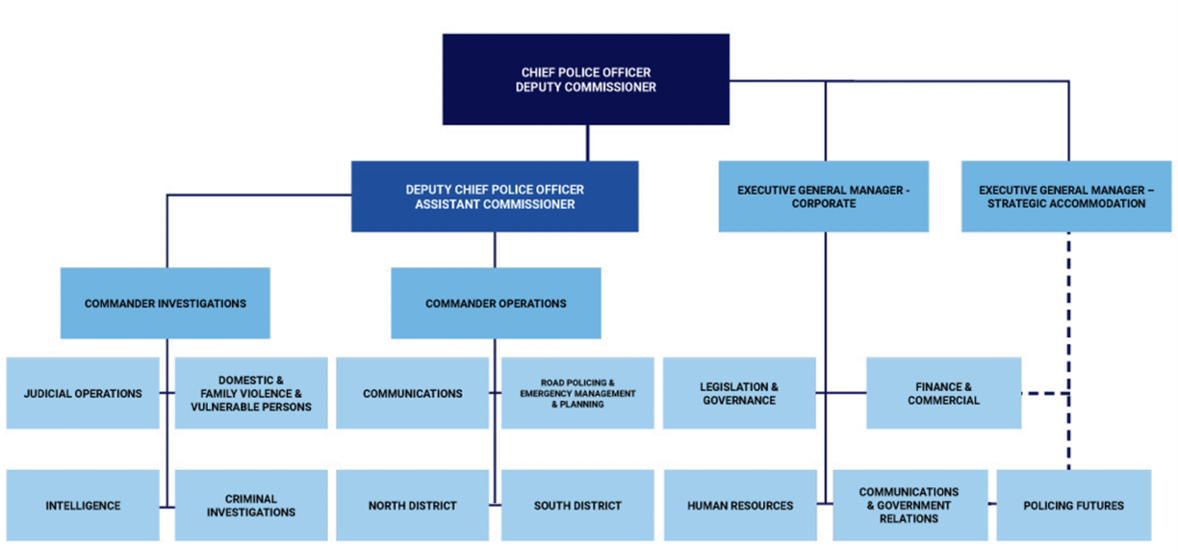
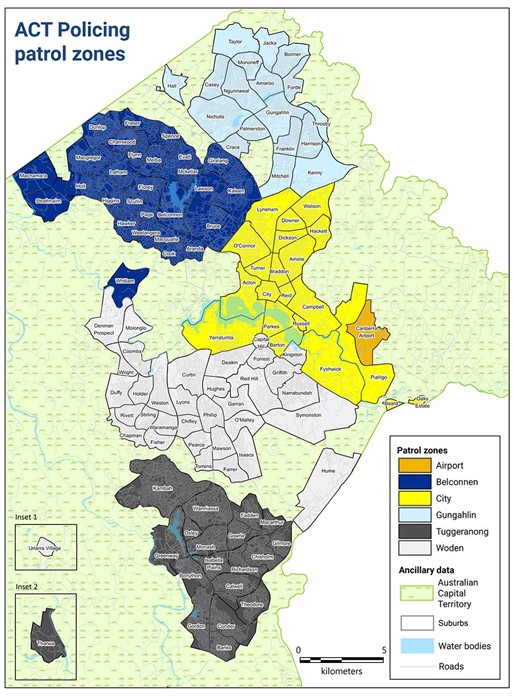
Figure 3.2. ACT Policing patrol zones as at 30 June 2025
Our Future
At ACT Policing we are focusing on research and innovation to remain contemporary and agile in the dynamic operating environment, supporting our ability to achieve operational outcomes and build confidence in the Canberra community.
The ACT Policing Futures capability is continuing to ensure ACT Policing evolves in line with an innovation-driven policing agency, adapting swiftly and sustainably to change and delivering an efficient and effective policing service to meet the future needs of the ACT community.
Through undertaking research and projects that align with the pillars of the ACT Policing Strategic Direction 2024–27, the Ministerial Direction and the CPO’s Statement of Intent, the Futures team supports ACT Policing’s vision of a highly visible, responsive and proactive police service that is underpinned by a healthy, professional and skilled workforce committed to continuously improving capabilities and working collaboratively with partners.
Areas of focus during 2024–25 include:
- Technology projects driven by rapid innovation and resourcing pressures to optimise operational outcomes, enhance public accessibility and create a more positive experience for the community.
- Supporting members’ wellbeing so our people are engaged, healthy and resilient.
- Research delivery guided by fundamental principles to generate outcomes which inform and enhance policing practices and methodologies.
- Identifying new and enhanced processes and capabilities to drive internal efficiencies and more effective allocation of police resources in response to current demands and member workloads.
Through working collaboratively with AFP and external partners, high-quality sustainable solutions were delivered with wide adoption bringing benefits both to ACT Policing and the community.
Our Community
ACT Policing is working to address ACT Government key priority policy objectives
- 204 referrals to Early Intervention & Drug Diversion Program
- 10,129 ThinkUKnow Program delivered
- 5,681referrals to SupportLink Services
- 11,094 Victim Liaison Officer contacts
- Completion of the ACT Policing Strategy for Engagement with First Nations People and Communities
- The expansion of ACT Policing’s online reporting to include dangerous driving, theft and lost property
- Co-delivery of the Living Safe Together Intervention Program
- Member of the ACT Disability Justice Strategy Reference Group
- Providing one-on-one support for Family Violence Safety Action Program and Multicultural Hub clients navigating the ACT legal system
Case study: Naloxone – protecting our members
The risk of ACT Policing members being exposed to dangerous opioids has increased in recent times with the prevalence of synthetic opioids throughout Australia presenting a significant threat to the health and safety of members.
Sadly it is not uncommon for ACT Policing to be called to the scene of an overdose which increases the risk of exposure to opioids such as Fentanyl, Nitazenes and Ketamine.
Exposure may occur through inhalation, ingestion or absorption through skin or eyes. In the event of exposure, opioids cause rapid onset of symptoms, which, if not treated promptly, can result in unconsciousness, breathing difficulties and potentially death.
To ensure our members are protected when attending incidents where it is suspected that there has been opioid use, ACT Policing’s Injury Management and Prevention Team have facilitated the introduction of Naloxone alongside first aid kits.
This lifesaving medication can treat accidental exposure to opioids or an opioid overdose.
Naloxone counteracts and reverses the effects of the opioid drug by rapidly displacing opioids from opioid ‘receptors’ in the body. Naloxone reverses respiratory depression which, if not treated early, may cause death. It is a conveniently packaged, ready-for-single-use, intra-nasal spray with a regulated dosage. Nasal Naloxone generally takes effect within minutes, with the ability to administer multiple doses 2–3 minutes apart if the casualty’s condition does not improve following the initial dose.
With police officers often being the first on scene, it can also be administered to a member of the public where an opioid overdose is suspected supporting the principles of first aid to preserve life, prevent further harm and promote recovery.
This is a significant benefit to the community but also to police officers because preventing a drug overdose death will reduce the harmful trauma they face when dealing with these situations.
Case study: Safe Summer Campaign
ACT Policing’s ‘Sergeant Geoff says... Have a Safe Summer’ social campaign ran from 11 December 2024 to 28 February 2025 encouraging safe attitudes and behaviours, particularly in relation to alcohol, partying and personal safety.
The summer months in the ACT historically result in an increase of alcohol-related incidents and arrests due to the increase of traffic, parties and nightlife in licensed venues, along with public holidays and events such as Christmas and New Year’s Eve.
The annual Safe Summer campaign targets teenagers and young adults who consume alcohol and/or drugs to varying levels. To effectively engage with these patrons, digital video and still image advertising was promoted across social media platforms including Facebook, Instagram and SnapChat.
Print media was displayed within licenced venues and local notice boards across Canberra City. The campaign’s namesake, Sergeant Geoff Hyde from Territory Targeting Team (TTT), handed out stickers promoting the Safe Summer campaign. An addition to this year’s campaign was Mini-Sergeant Geoff, a lookalike puppet who helped break stereotypes that police officers are serious all the time, and are approachable and there to help.
The publicly well-received campaign was a result of collaboration across many different teams within ACT Policing. These included Strategic Communications, Media, Production, Digital Engagement, the ACT Policing Executive team, TTT and Constable Kenny Koala.
The campaign also relied on the work of many external stakeholders. These included the Minister for Police, Fire and Emergency Services, Marisa Paterson, and Canberra licenced venues, in addition to St John Ambulance ACT who provided a safe environment within the Canberra CBD through the CBR Night Crew program. Furthermore the Sobering Up Shelter offered a voluntary, confidential service that provides overnight support, care and monitoring for people over the age of 18 recovering from alcohol and other drug intoxication.
Sergeant Hyde acknowledged increased engagement from patrons recognising him from the social media promotion, which saw both he and Mini-Sergeant Geoff frequently asked to partake in selfies.
ACT Policing’s social media channels played a big role in the campaign with the highest-performing post – which focused on one-punch assaults – receiving more than 544,253 impressions, while the ‘It’s Time to Go When They Say So’ video performed well with 21,682 views.
Operationally, TTT advised that Canberra patrons were generally well behaved over the busy summer period and the team, Mini-Sergeant Geoff included, look forward to the next campaign.
Case study: ACT Policing Wellness Program
The ACT Policing Wellness Program was launched on 16 December 2024 and aims to support ACT Policing members in maintaining their physical and mental health.
An initiative of the ACT Policing Futures Team, the program was developed as a direct result of feedback from members, a clear example of member input and ideas resulting in tangible and effective outcomes for the workforce.
The program allows ACT Policing members to use up to 90 minutes per week within normal working hours, for activities which support physical or mental health.
The program is based on research which suggests that regular health-based activity reduces stress and anxiety, increases employee engagement and productivity, reduces absences from work and can improve employee work–life balance.
Since the program launch 394 members have completed the onboarding survey and the Futures team has visited more than 40 ACT Policing teams, including 30 General Duties teams, to discuss the program and receive feedback. This included making changes to better protect the time within General Duties rosters, while still maintaining operational requirements.
Members have been using the wellness time for individual gym sessions or group fitness classes, swimming, walks and runs in the local area, listening to podcasts, reading a book, visiting the police Chaplain or attending health classes.
Use of ACT Policing gyms and group fitness classes have seen a sharp increase in attendance since the start of the program.
Members have already felt the benefits of wellness time and have provided feedback:
“Using the Wellness Program has me feeling part of the team as we do many team activities, where before I’d come to work and then go home.”
“Having time to work out prior to my shift allows me to spend more time with my family.”
“This is a progressive people- centric wellbeing option that many ‘employers of choice’ offer – I am proud that ACT Policing is moving in this direction too!”
“I feel extremely motivated to turn up to work.”
“Being able to maintain my fitness during work hours, I feel happier and less stressed.”
“I have never been fitter or felt better whilst at work which I put down to the program.”
“I feel I can better focus on my work when I am able to get my body moving.”
The success of the program for ACT Policing has seen the initiative expanded across selected areas of the AFP.
4. Performance Analysis
- Performance Measures
- Outcome: Prevent Crime
- Outcome: Reduce Recidivism
- Outcome: Prevent Road Deaths and Trauma
- Outcome: Divert
- Outcome: Disrupt
- Outcome: Respond
- Outcome: Enforce
- Outcome: Community
- Confidence
- Other Reporting
2024 - 25 Snapshot
Community policing
- 51,802 incidents attended
- 4,115 mental health related incidents attended
- 4,012 arrests made
- 1,227 summons issued
- 4,478 domestic & family violence incidents attended
- 597 intoxicated persons lodged in protective
Media
- 568 media releases issued
- 651 media enquiry responses provided
Online reporting
- 127 reports of historic sexual assault
- 1,086 reports for property damage & vandalism
- 401 reports of petrol drive offs
- 469 reports of minor theft *this data is from 14 May 2025 to 30 June 2025*
- 1,816 reports of dangerous driving
- 137 reports of lost property *this data is from 14 May 2025 to 30 June 2025*
Social media
- 65,362 X followers (ACT Policing & Traffic channels)
- 1,162,344 X impressions
- 30,668 Instagram followers
- 5,969,441 Instagram impressions
- 169,043 Facebook followers
- 60,532,734 Facebook impressions
Community engagement
- 25+ community requests facilitated
- 29 community events attended
ACT Policing website
- 1.8m+ unique page views police.act.gov.au * since October 2024 ACT Policing has transitioned to one website
Orders & briefs
- 1,800+ family violence orders
- 1,018 personal protection orders
- 1,395 hearing briefs delivered to Director of Public Prosecution
Intervention
- 5,681 referrals to community support agencies
- 17 restorative justice conferences
- 866 drug seizures
- 204 referrals to Early Intervention & Drug Diversion Program
Constable Kenny Koala (CKK) program
- 1,486 class presentations
- 33 community events attended
- 27,957 students visited
- 21,000 unique page views for CKK website
Performance Measures
ACT Policing, in partnership with the community, is creating a safer and more secure ACT through the provision of quality police services.
On 25 November 2022 the ACT Minister for Police and Crime Prevention, the AFP Commissioner and the CPO announced the start of the new four-year ACT Policing 2022–26 Purchase Agreement.
The agreement details the policing services purchased by the ACT Government from the AFP. The new agreement remains a high-level, principles-based document that seeks to provide guidance on how ACT Policing and the ACT Government work together to provide a community policing capability consistent with the ACT community’s expectations.
Key changes under the 2022–26 Purchase Agreement include:
- Earlier emphasis on the AFP’s obligation to align policing services with ACT Government priorities in recognition of the overarching policy environment within which ACT Policing operates.
- Enhancing the governance for enabling services through service level agreements in place between ACT Policing and the AFP.
- The introduction of an annual CPO’s Statement of Intent, which will set out strategies and plans ACT Policing will implement to address the ACT Government’s key priorities and the Ministerial Direction.
- The Performance Measure Framework (Schedule 1 of the Agreement) now appropriately differentiates Shared ACT Government Outcomes from Key Performance Indicators, with the latter focused on operational outcomes within the control of ACT Policing.
- This recognises ACT Policing as part of a multi-agency response supporting the ACT Government in navigating complex social issues. Additionally, the new targets are designed to be more consistent and fluid, and therefore more contemporaneous, allowing ACT Policing to analyse any potential underlying issues in data and/or policies.
- The 2022–26 Purchase Agreement outlines 21 Performance Measures under two sets of outcomes, against which ACT Policing’s performance is measured.
A full summary of all offences reported and cleared by ACT Policing, in addition to the number of proceedings against offenders, can be found in Appendices 3–6.
The 2022–26 Purchase Agreement includes three Performance Measures (16, 19 and 20) based on the results of the National Survey of Community Satisfaction with Policing. The National Survey of Community Satisfaction with Policing is a telephone survey (landline and mobile telephone numbers) which measures community perceptions on a range of policing-related issues. These issues include satisfaction with policing services, feelings of safety, concern about potential victimisation and beliefs about police behaviour. During 2024–25, 2,001 ACT residents participated in the survey, with 20,659 people participating nationally.
The following data in this chapter provides an overview of each Performance Measure against the 2024–25 target, the achieved result and the reason for variation, if any.
Data for the selected Performance Measures and comparison tables was extracted from ACT Policing’s case management system Police Real-time Online Management Information System (PROMIS) on 2 July 2025. It is important to note that ACT Policing’s database is live and crime data is continually revised, therefore crime statistics may differ depending on the date of extraction.
Shared ACT Government Outcomes
Outcome: Prevent Crime
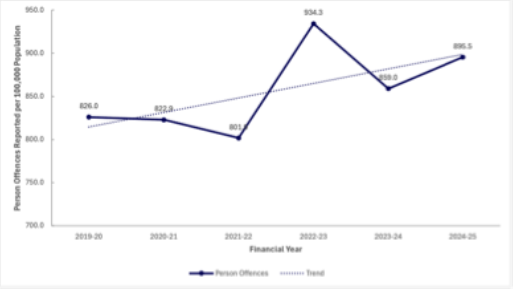
Performance Measure 1 – Number of offences against the person reported or becoming known per 100,000 population
- Date range: 1 July 2024 to 30 June 2025
- Monitor: 5 year trend
- Result: 895.5
Figure 4.1. Total offences against the person reported or becoming known per 100,000 population – 5-year trend
Source: PROMIS, 2 July 2025
There were 895.5 offences against the person reported or becoming known per 100,000 population in 2024–25.
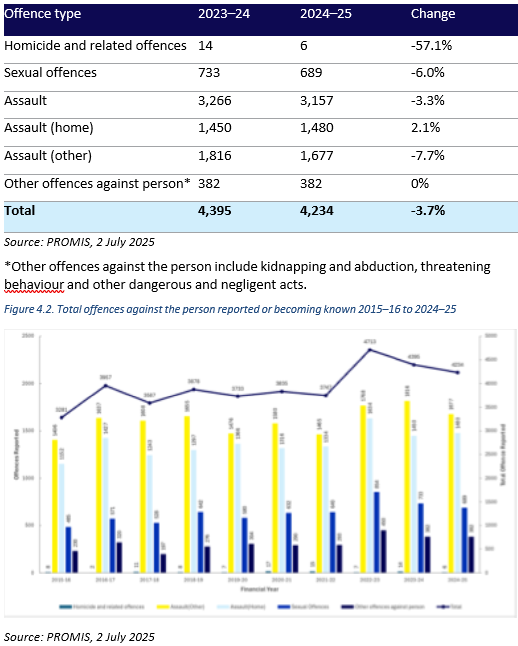 * Other offences against the person include kidnapping and abduction, threatening behaviour and other dangerous and negligent acts.
Figure 4.2. Total offences against the person reported or becoming known 2015–16 to 2024–25
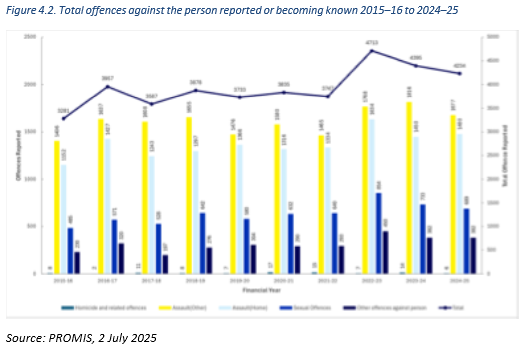
There was a total of 4,234 offences against the person reported to ACT Policing in 2024–25. This was a decrease of 3.7 per cent (or 161 offences) compared to 2023–24.
Overall assault offences in 2024–25 decreased by 3.3 per cent compared to 2023–24.
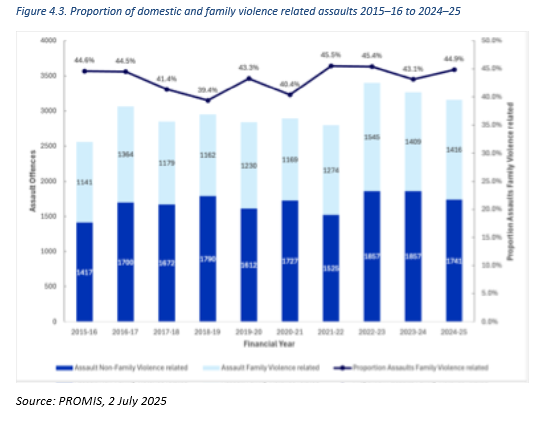
Of those assault offences reported to ACT Policing, 44.9 per cent were domestic and family violence related, as shown in Figure 4.3.
Figure 4.3. Proportion of domestic and family violence related assaults 2015–16 to 2024–25
Case Study: Domestic and Family Violence Investigation Unit
Since its launch in 2024 the Domestic and Family Violence Investigation Unit (DFVIU) has carried out holistic investigations and case-management of high-risk Domestic and Family Violence (DFV) matters. The aim of the unit is to reduce the risk and incidence of DFV homicide in the ACT and repeat calls for service, while ensuring a consistent response to DFV incidents.
Police response to DFV has traditionally focussed on the investigation of stand-alone incidents. ACT Policing recognised this model does not always meet the needs of DFV victim-survivors as many experience DFV not as incidents but as chronic fear and control, highlighted by incidents, over an extended period of time.
When only focused on standalone incidents, responding officers and the courts are not informed by the broader history and context of the relationship. What’s more, requiring a victim-survivor to re-tell their story to a new officer each time is a barrier to reporting and is not victim centric or trauma informed.
The benefits of a holistic DFV investigations model include consideration of individual incidents in the context of the broader DFV relationship, and a single point of contact for victims-survivors.
How the model was created
The unit and operating model design is based on extensive analysis and consultation with external partners including the Domestic Violence Crisis Service, Family Violence Safety Action Program and academic experts in DFV. The team will continue to evaluate and make adjustments based on what works and what could be improved.
What we do and how we do it
The team consists of sworn and unsworn members who work in varying roles, including Child Protection Liaison Officers who manage most referrals between ACT Policing and external organisations.
Referrals to DFVIU can come from:
- patrol, based on risk of lethality and/or repeat violence
- intelligence-led identification of high-risk cases and cases causing repeat calls for service
- direct-referral pathways from DFV sector partners including:
- Domestic Violence Crisis Service
- Family Violence Safety Action Program
- Women’s Legal Centre ACT
The work of the DFVIU in 2024–25
Sadly there were a total of 4,478 DFV related incidents reported to ACT Policing in 2024–25; that’s an average of 12 DFV incidents reported per day.
During this period the DFVIU laid 163 charges related to DFV incidents. These charges related to 36 individual offenders.
Future enhancements
A revised DFV training continuum for all ACT Policing officers is being developed in partnership with ACT Government’s Domestic, Family and Sexual Violence Office who are providing the funding for specialist coercive control training.
Performance Measure 2 – Number of offences against property reported or becoming known per 100,000 population
Figure 4.4. Offences against property reported or becoming known per 100,000 population – 5-year trend
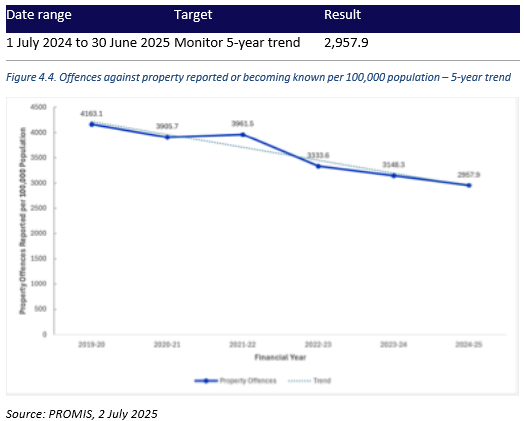
There were 2,957.9 property offences reported or becoming known per 100,000 population in 2024–25. Figure 4.4 shows a long-term downward trend for reported property offences per 100,000 population.
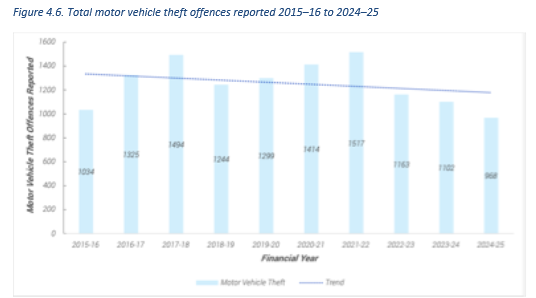
Figure 4.5. Total offences reported against property 2015–16 to 2024–25
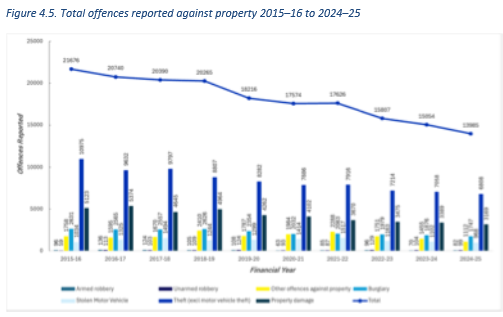
There was a total of 13,985 offences against property reported to ACT Policing in 2024–25. This was a decrease of 7.1 per cent (or 1,069 offences) compared to 2023–24.
Table 4.2. Offences against property by offence type – financial year comparison
Offence type | 2023–24 | 2024–25 | Change |
Robbery | 174 | 181 | 4.0% |
Armed robbery | 70 | 82 | 17.1% |
Unarmed robbery | 104 | 99 | -4.8% |
Burglary | 1,876 | 1,747 | -6.4% |
Burglary dwellings | 947 | 718 | -24.2% |
Burglary shops | 331 | 223 | -32.6% |
Burglary other | 598 | 806 | 37.1% |
Motor vehicle theft | 1,102 | 968 | -12.2% |
Other theft | 7,058 | 6,808 | -3.5% |
Property damage | 3,389 | 3,169 | -6.5% |
Other offences against property* | 1,455 | 1,112 | -24.1% |
Total | 15,054 | 13,985 | -7.1% |
* Other offences against property include fraud and misappropriation, handling of stolen goods, environmental offences, blackmail and extortion, and other property offences not elsewhere classified.
 Source: PROMIS, 2 July 2025
Case study: City Safe – supporting Canberra businesses
In July 2024 ACT Policing launched a City Safe campaign aimed at addressing criminal and anti-social behaviour in the City and immediate surrounds.
The campaign was established following Chief Police Officer Scott Lee meeting with City business owners who raised concerns about criminal activity impacting on their feeling of safety and their businesses.
Throughout the month members from across ACT’s five police stations plus Road Policing and the Proactive Intervention and Diversion Team undertook the high-visibility operation. The collaborative effort was integral to the success of the campaign.
The City Safe campaign focused on policing licenced premises, local businesses and high-foot-traffic areas in the City and Braddon precincts. The campaign saw 45 people arrested, with a further 59 issued cautions or move-on notices.
Offences included assault, theft, fighting in a public place, possessing stolen property, defacing public property, drinking in a public place and breaching good behaviour orders.
In addition to addressing criminal behaviour, the campaign also gave officers an opportunity to continue their engagement with local businesses and the community.
Throughout the duration of the campaign, the high-visibility presence allowed ACT Policing to respond quickly to any criminal acts that were observed but also served as a strong deterrent for anyone considering engaging in such behaviour.
ACT Policing continues to support businesses across Canberra through education, enforcement and engagement.
Case study: Operation Archon: ACT Policing and the royal visit
As dawn broke over Canberra on Monday 21 October 2024 the air at the Police Operations Centre and Joint Intelligence Group at Winchester Police Centre buzzed with anticipation.
The city was adorned with spring flowers and small crowds gathered along the streets in eager expectation of a momentous occasion: the arrival of His Majesty King Charles III and Her Majesty Queen Camilla.
ACT Policing had meticulously prepared for this day, ensuring every detail of the royal visit was secured.
The visit was the culmination of months of planning by the Command Emergency Management and Planning Team in collaboration with all areas of ACT Policing. When international delegates visit a country, their safety and the smooth execution of their itinerary rely heavily on meticulous planning and coordination by law enforcement and government agencies. These visits often involve complex layers of logistics, security and protocol, each managed by dedicated professionals working behind the scenes.
The motorcade rolled through the capital, a convoy gliding smoothly along the roadways, thanks to the forward planning of ACT Policing. Officers positioned at intersections kept the route clear, their presence both reassuring and respectful. The excitement was evident, with onlookers waving and cheering as Road Policing Officers lead the motorcade and the royal car passed by.
One of their first stops was the Australian War Memorial, where the King and Queen were greeted by 4,000 Canberrans eager to catch a glimpse of the royal couple. Their Majesties paid homage to those who had served the nation, laying a wreath and honouring the sacrifices made by countless Australians. ACT Policing and AFP members worked diligently to manage the crowds, monitoring and responding to protest activity as required to ensure their Majesties were able to safely conduct their duties.
The crowd was managed with a mix of policing methods as well as the enacting of the Major Events Act 2014.There was a small protest group who attempted to interfere with the event but they were quickly deterred by public order trained police.
Next, their Majesties arrived at the Australian Parliament House where they were greeted by government officials and dignitaries, with a Ceremonial Welcome on the forecourt and a 21-gun salute. As they walked through the grand halls, the importance of the occasion settled in – an opportunity to strengthen ties between the United Kingdom and Australia.
At Government House the couple engaged with the Prime Minister and Leader of the Opposition, before planting a tree with several school kids watching on.
The day culminated at the National Botanic Gardens. ACT Policing arrived earlier in the day to secure the site with the location closed for the day with fences closed and gates guarded.
The meticulous efforts of ACT Policing, the forward planning and security detail, the teamwork and collaboration across law enforcement and the warmth of Canberrans created a memorable chapter for everyone involved.
While the visit to Canberra lasted less than a day, countless hours were dedicated to planning and preparation for the event. More than 350 staff from across ACT Policing and the broader AFP were called in to assist. The success of the visit is a direct result of the hard work and dedication of ACT Policing Officers, and an acknowledgement of the skills and experience across ACT Policing in managing and facilitating Guest of Government visits.
Case study: Cocaine now included in roadside testing
As of 1 January 2025 ACT Policing has expanded its roadside drug testing program to include cocaine, in addition to cannabis, methamphetamines and MDMA. This initiative is part of a broader effort to enhance road safety and reduce drug-impaired driving incidents in the ACT.
Despite recent changes in drug possession laws, including the decriminalisation of cannabis, drug driving remains a serious offence due to the significant risks it poses to road safety. The ACT maintains a zero-tolerance approach to drug driving, making it an offence to have any illicit drug in your system. Similar to alcohol, drugs can severely affect driving abilities and increase the likelihood of a collision.
The impact of the new law was immediate. Just hours after it took effect, a 19-year-old male was stopped for random drug and alcohol testing in Campbell and tested positive for cocaine. He was subsequently taken to City Police Station, where a secondary test confirmed the presence of cocaine. The male was convicted in April 2025 and was issued a Good Behaviour Order.
Drivers in the ACT caught with cocaine in their system may face fines of up to $4,000 and a default license disqualification of six months. In January 2025 alone ACT Policing conducted 488 roadside drug tests. There were 45 oral fluid samples that tested positive for illicit drugs, 12 of these were positive for cocaine, representing 26.7 per cent of positive tests.
Drug and drink driving are among the top five contributing factors to death and serious injury on ACT roads. Keeping impaired drivers off the roads is a key priority for ACT Policing. In the 2024–25 financial year ACT Road Policing conducted 99,181 Random Breath Tests and 3,767 Roadside Drug Tests, resulting in 628 charges for drink driving and 331 charges for drug driving.
Outcome: Reduce Recidivism
Performance Measure 3 – Proportion of offenders proceeded against by police more than once within the previous 12 months
Date range | Target | Result |
1 July 2024 to 30 June 2025 | Monitor 5-year trend | 20.6% |
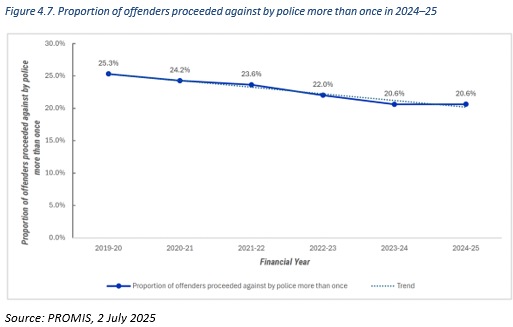
The proportion of offenders proceeded against by police more than once in 2024–25 was 20.6 per cent. This continues the downward trend since 2019–20 and is the equal lowest proportion of offenders proceeded against more than once in the last five years.
Outcome: Prevent Road Deaths and Trauma
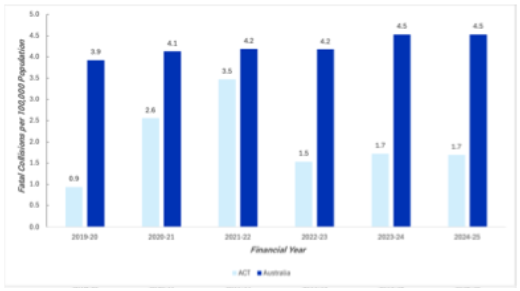
Performance Measure 4 – Number of road crashes resulting in death per 100,000
Date range | Target | Result |
1 July 2024 to 30 June 2025 | Monitor 5-year trend | 1.7 deaths per 100,000 people |
Figure 4.8. Road fatalities per 100,000 population
Source: PROMIS, 2 July 2025 and Australian Road Deaths Database, 30 June 2025
The number of road crashes resulting in death per 100,000 in 2024–25 was 1.7.
Performance Measure 5 – Number of road crashes resulting in injury per 100,000
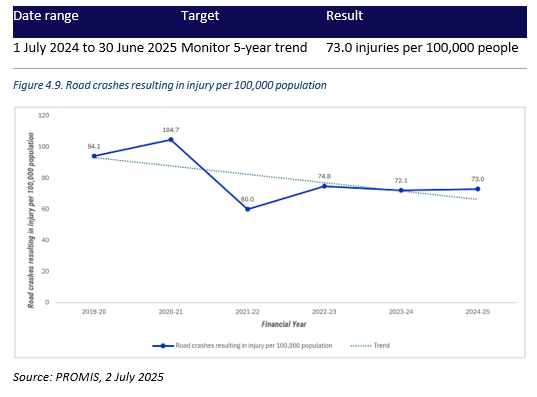 The number of road crashes resulting in injury per 100,000 in 2024–25 was 73.0.
Figure 4.10. Total road crashes resulting in injury
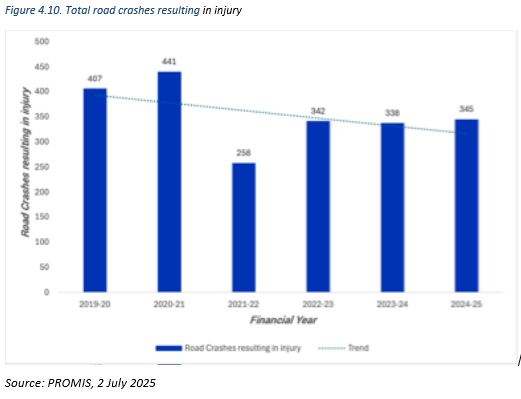
The total number of road crashes resulting in injury in 2024–25 was 345.
ACT Policing Operational Outcomes
Outcome: Divert
Performance Measure 6 – Percentage of eligible young people referred to Restorative Justice
Performance Measure 6.1 Young First Nations peoples
Date range | Target | Result | % variation from target | On target |
1 July 2024 to 30 June 2025 | 100% | 66.7% | -33.3% | N |
Of the three young First Nations peoples eligible for Restorative Justice in 2024–25, one was not referred, therefore ACT Policing did not meet the 100 per cent referral target for 2024–25.
Performance Measure 6.2 Young Non-First Nations peoples
Date range | Target | Result | % variation from target | On target |
1 July 2024 to 30 June 2025 | 100% | 94.3% | -5.7% | N |
Of the 35 young non-First Nations peoples eligible for Restorative Justice in 2024–25, two were not referred, therefore ACT Policing did not meet the 100 per cent referral target for 2024–25.
Performance Measure 7 – Percentage of offenders proceeded against by non-court actions (diversions and cautions)
Performance Measure 7.1 First Nations peoples
Date range | Target measure | Actual target | Result | % variation from target | On target |
1 July 2024 to 30 June 2025 | 5-year average or more | 6.2% | 5.7% | -0.5% | N |
The percentage of First Nations offenders proceeded against by non-court actions (diversionary conferences, alcohol and drug diversions and cautions) in 2024–25 was 5.7 per cent. This was 0.5 per cent below the target of 6.2 per cent (average over the past five years)
Performance Measure 7.2 Non-First Nations peoples
Date range | Target measure | Actual target | Result | % variation from target | On target |
1 July 2024 to 30 June 2025 | 5-year average or more | 12.8% | 12.2% | -0.6% | N |
The percentage of non-First Nations offenders proceeded against by non-court actions (diversionary conferences, alcohol and drug diversions and cautions) in 2024–25 was 12.2 per cent. The result was 0.6 per cent below the target of 12.8 per cent (average over the past five years).
Performance Measure 8 – Number of persons referred to community support agencies (SupportLink)
Date range | Target measure | Actual target | Result | % variation from target | On target |
1 July 2024 to 30 June 2025 | 5-year average or more | 5,935 | 5,681 | -4.3% | N |
There were 5,681 referrals to SupportLink in 2024–25, which was 4.3 per cent below the five-year average of 5,935.
SupportLink provides a national referral and diversion gateway for police and other emergency services to participate in early intervention. The role of SupportLink is to reduce crime, suicide, violence, substance abuse, family breakdown and juvenile offending, and to improve support for victims of crime.
The annual target for this measure is based on the average number of persons referred to community support agencies over the previous five years. For the periods covering the COVID-19 pandemic the numbers of referrals declined but have increased since then.
Outcome: Disrupt
Performance Measure 9 – Number of disruption activities (drug related, general person offences, general property offences or organised motorcycle gang related)
Date range | Target | Result |
1 July 2024 to 30 June 2025 | Monitor 5-year trend | 897 |
Figure 4.11. Number of disruption activities
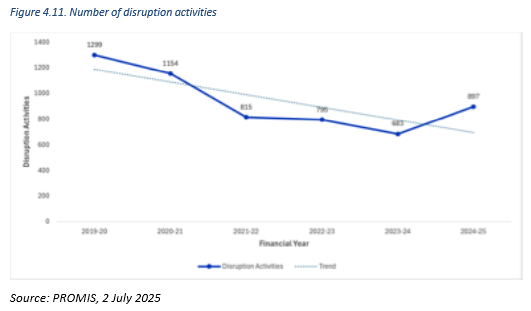
The number of disruption activities for 2024–25 was 897. Overall, a downward trend in disruption activity since 2019–20 has been observed.
Performance Measure 10 – Disruption Case Study
Case study: Operation Margate: Targeting the cultivation of illicit cannabis
Thousands of illegal cannabis plants worth more than $9 million have been destroyed thanks to the dedication and perseverance of ACT Policing’s Operation Margate.
Operation Margate is an ongoing investigation which began in 2023 and targets the commercial cultivation of cannabis by Vietnamese Organised Crime syndicates operating within the ACT.
While the Drugs and Organised Crime Team have the lead on this operation, the success so far is due to collaboration of multiple areas across the AFP including forensics, specialist areas, Proactive Intervention and Diversion Team, Taskforce Invidia (Outlaw Motorcycle Gangs), General Duties and Criminal Assets Investigation.
Working closely with Australian Border Force, New South Wales Police, Queensland Police and Victoria Police Operation Margate has garnered impressive results:
- 14 grow houses dismantled within the ACT.
- 2,613 cannabis plants seized and destroyed worth approximately $9 million in street value.
- An estimated $800,000 worth of hydroponic gear seized and destroyed.
- Four houses (three in ACT, one in NSW) restrained by the Criminal Assets Investigations Team (CAIT), valued at approximately $4.6 million total.
- One vehicle restrained, valued at approximately $10,000.
To date six offenders have been arrested with five pleading guilty and the sixth failing to appear.
One offender was extradited into the care of Victoria Police for a Melbourne County Court warrant for similar offences, post ACT sentencing.
There is also currently one offender in detention awaiting deportation.
Besides the clear hazards posed by illicit substances to the community, the grow house facilities themselves create a dangerous risk.
Between 2019 to 2023 four grow houses within the ACT (all rentals) caught fire due to poor quality electrical work causing significant risk to emergency services and the public. Since 2023 and the instigation of Operation Margate there have been no grow house fires.
Members from Operation Margate continue to educate the community around the dangers of grow houses via ongoing radio interviews and media stand-ups. They also encourage all members of the public who may have information on the cultivation of illicit substances to contact Crime Stoppers.
Case study: Operation VITREUS: Millions in drugs and cash seized
In August 2024 ACT Policing participated in Operation VITREUS, a coordinated national week of action targeting the sale and distribution of illicit drugs. This initiative, involving all state and territory police forces, focused on dismantling drug trafficking networks through highly visible, intelligence-led operations across Australia.
Operation VITREUS in the ACT was marked by meticulous planning and effective inter-agency collaboration. Over the course of the operation ACT Policing executed 15 search warrants throughout Canberra. These efforts led to the seizure of more than 1,000 cannabis plants and more than 42 kilograms of dried cannabis material, with a combined estimated value of $3.1 million. Additionally, approximately 280 grams of cocaine were confiscated, together with more than half a million dollars in cash.
The searches also uncovered significant ancillary criminal activity. At a residence in Gungahlin, officers located a firearm and hundreds of rounds of ammunition. Further seizures included illegal fireworks, steroids and a prohibited knife, underscoring the interconnectedness of drug crime and other illegal activities.
As a result of these investigations two individuals were arrested at a property in Flynn and charged with multiple offences related to the cultivation and distribution of cannabis. Authorities also restrained two properties (in Flynn and Fraser) and two vehicles (a Toyota Camry and a Toyota Tarago) under proceeds of crime legislation, disrupting the financial underpinnings of the illicit enterprise.
A key outcome of Operation VITREUS was the dismantling of four grow houses within the ACT, with intelligence gained during the week leading to the discovery of a fifth site – housing more than 200 cannabis plants – where inquiries remain ongoing.
The success of Operation VITREUS highlights the value of collaboration between ACT Policing and partner agencies, as well as the importance of proactive, intelligence-driven policing in addressing serious and organised crime. The operation demonstrates ACT Policing’s ongoing commitment to protecting the community by targeting and dismantling criminal networks at both local and national levels.
Case study: Protecting the community from illegal vape and cannabis sales in the ACT
In August 2024 General Duties members at Gungahlin Police Station
commenced an investigation into a syndicate allegedly operating a mobile delivery service in the ACT and surrounding areas for vapes, cannabis and cannabis edibles (cannabis-laced gummies and hash cookies).
It is estimated the syndicate was making between $2,000 to $3,000 per day and was predominately selling to teenagers across the ACT.
It was identified that a child as young as 12 had purchased hash cookies and cannabis- laced gummies using this delivery service.
It was also identified that a 15-year-old female student suffered a medical episode at school after consuming cannabis gummies purchased from the mobile delivery service, resulting in her being transported via ambulance to hospital.
During its investigations, ACT Policing observed a man conducting multiple exchanges of goods from his vehicle at multiple locations. Some of these deals were being made in close proximity to Canberra secondary schools and also to students in school uniform.
In early September 2024 during a traffic stop on the ‘delivery’ vehicle, police identified and seized several items including vapes, cannabis, cash, gummies and other drug paraphernalia. A search warrant was then executed at a private residence linked to the driver.
On 6 September 2024 police, assisted by the Forensic Crime Scene team, executed a search warrant at a Franklin address where it was suspected the syndicate was storing its main supply of vapes and cannabis. Crime scene members examined manufacturing and grinding equipment, vape boxes, cookware, jelly moulds and product packaging.
Specifically, more than 600 vapes were found within the premises, in addition to grow tents, hydroponic paraphernalia, lighting, packaging, drying racks, plant enhancers and processing equipment. Police seized a range of packaged cannabis products in the shape of bears and leaves, as well as cannabis liquid and gelatine crystals.
Fingerprints developed on vape boxes and packaging material, and trace DNA swabs sampled from cookware, led to identifying a suspect.
One of the many concerns of ACT Policing was the unhygienic and unmeasured way the cannabis products were being produced and the unknown effect this had on the potency and ingredients of the gummies.
On 25 October 2024 General Duties members from Gungahlin Police Station acting on information from Australian Border Force (ABF), intercepted a consignment at a
Canberra Courier company in Hume in the ACT. The package contained 130 kilograms of vapes from China.
Further information from ABF revealed several previous large consignments weighing hundreds of kilograms from China had been delivered to these same addresses and were suspected to have contained vapes.
On 29 October 2024 police executed search warrants and seized approximately 300 vapes, just under 2 kilograms of dried cannabis and more than $19,000 suspected to be the proceeds of crime.
Across the entire investigation, police executed search warrants on five premises in the ACT and charged five members of the syndicate with multiple offences including manufacturing and trafficking in a large commercial quantity of a controlled drug (cannabis-laced gummies), trafficking in a trafficable quantity of cannabis and supplying cannabis to a child.
In addition to these charges, some members of the syndicate were charged with offences for the first time in the ACT, including:
- possessing at least the commercial quantity but less than 100 times the commercial quantity of vaping goods
- attempting to possess at least 100 times the commercial quantity but less than 1,000 times the commercial quantity of vaping goods
- supplying vaping goods
- attempting to import vaping goods into Australia
- not storing cannabis out of reach of children.
All defendants in this matter are currently still before the court.
ACT Policing is confident that this syndicate supplying vapes, cannabis and cannabis products predominately to teenagers has been completely dismantled.
Performance Measure 11 – Number of targeted traffic operations (in line with the 2024–25 Road Safety Calendar)
Date range | Target | Result |
1 July 2024 to 30 June 2025 | Monitor 5-year trend | 19 |
There were 19 targeted traffic operations by ACT Road Policing in 2024–25. This takes into account one operation per month in line with the Road Safety Calendar and additional operations including, but not limited to, major events like Summernats and seasonal awareness campaigns including Operation Snow Safe and the Kings Highway Easter campaign.
Outcome: Respond
Performance Measure 12 – Average length of time to respond to Priority One incidents
Date range | Target measure | Actual target | Result | % variation from target | On target |
1 July 2024 to 30 June 2025 | 5-year average or less | 7.9 minutes or less | 6.4 minutes | -19.7% | Y |
The average length of time to respond to Priority One incidents was 6.4 minutes in 2024–25. This was 19.7 per cent below the maximum target of 7.9 minutes, which was the average response time for Priority One incidents over the past five years.
Performance Measure 13 – Average length of time to respond to Priority Two incidents
Date range | Target measure | Actual target | Result | % variation from target | On target |
1 July 2024 to 30 June 2025 | 5-year average or less | 17.6 minutes or less | 17.4 minutes | -1.2% | Y |
The average length of time to respond to Priority Two incidents was 17.4 minutes in 2024–25. This was 1.2 per cent below the target of 17.6 minutes, which was the average response time for Priority Two incidents over the past five years.
The high volume of Priority Two incidents reported to ACT Policing has presented challenges for ACT Policing in meeting Performance Measures relating to response times since 2015–16. The increase in Priority Two matters in the last five years has been a key driver of the result for this KPI. While the number of Priority Two incidents decreased by 4.9 per cent in the last 12 months, there was an increase of 9.8 per cent over the last ten years.
Performance Measure 14 – Percentage of Priority Three incidents responded to within 48 hours
Date range | Target | Result |
1 July 2024 to 30 June 2025 | Monitor 5-year trend | 95.1% |
Figure 4.12. Percentage of Priority Three incidents responded to within 48 hours
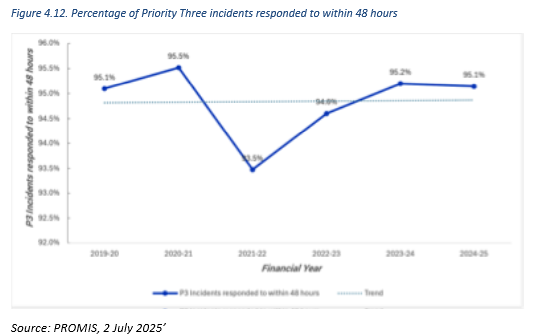
In 2024–25, 95.1 per cent of Priority Three incidents were responded to within 48 hours. This was a decline of 0.1 per cent compared to 2023–24.
Performance Measure 15 — Percentage of Triple Zero (000) calls answered
Performance Measure 15.1 – Percentage of Triple Zero (000) calls answered on first presentation
Date range | Target measure | Actual target | Result | % variation from target | On target |
1 July 2024 to 30 June 2025 | 5-year average or more | 90.8% or more | 91.4% | 0.6% | Y |
The percentage of Triple Zero (000) calls answered on first presentation was 91.4 per cent in 2024–25. This result was 0.6 per cent above the target of 90.8 per cent, which was the average percentage of calls answered on first presentation over the past five years.
ACT Policing applies the highest priority to answering Triple Zero (000) calls and aims to answer them within 10 seconds. Non-emergency calls to Triple Zero (000) reduce ACT Policing’s capacity to respond to genuine emergency incidents in a timely manner. ACT Policing Media continually remind the ACT community not to call Triple Zero (000) unless it is an emergency. Nuisance or hoax phone calls, even though they are low in volume, do exist and can impact on ACT Policing’s ability to respond to emergency calls. ACT Policing also observed an escalation in calls to the 131 444 line which has, in turn, meant longer call-wait times, leading to some callers contacting Triple Zero (000) instead.
Performance Measure 15.2 – Percentage of Triple Zero (000) calls answered on second presentation
Date range | Target measure | Actual target | Result | % variation from target | On target |
1 July 2024 to 30 June 2025 | 5-year average or more | 97.4% or more | 97.2% | -0.2% | N |
The percentage of Triple Zero (000) calls answered on second presentation was 97.2 per cent in 2024–25. This result was 0.2 per cent below the target of 97.4 per cent, which was the average percentage of calls answered on second presentation over the past five years.
Performance Measure 16 – Percentage of the community satisfied in general with the job police are doing in responding to emergencies and disasters
Date range | Target measure | Actual target | Result | % variation from target | On target |
1 July 2024 to 30 June 2025 | National average or more | 67.8% | 73.5% | N/A | N/A |
The results for this measure come from the National Survey of Community Satisfaction with Policing (NSCSP). In order to collect a sample large enough to be representative, the NSCSP introduced online collection methods in addition to phone interviews. This change has significantly impacted the NSCSP results as the method of collection is known to affect respondent answers.
The sampling mix also differs between jurisdictions. Accordingly, the 2024–25 data is not comparable to results in previous years, is not comparable between jurisdictions and cannot be used to derive a reliable national average.
The percentage of the community satisfied in general with services provided by police in responding to emergencies and disasters was 73.5 per cent in 2024–25, which was 5.7 per cent above the national average. However as the national average cannot be used as a reliable comparison there is no valid target for this measure.
Outcome: Enforce
Performance Measure 17 – Proportion of offenders proceeded against for person offences
Date range | Target measure | Actual target | Result | % variation from target | On target |
1 July 2024 to 30 June 2025 | 5-year average or more | 28.7% or more | 35.3% | 6.6% | Y |
The proportion of offenders proceeded against for person offences was 35.3 per cent in 2024–25. This was 6.6 per cent over the target of 28.7 per cent, which was the average over the past five years.
Figure 4.13. Proportion of offenders proceeded against for person offences
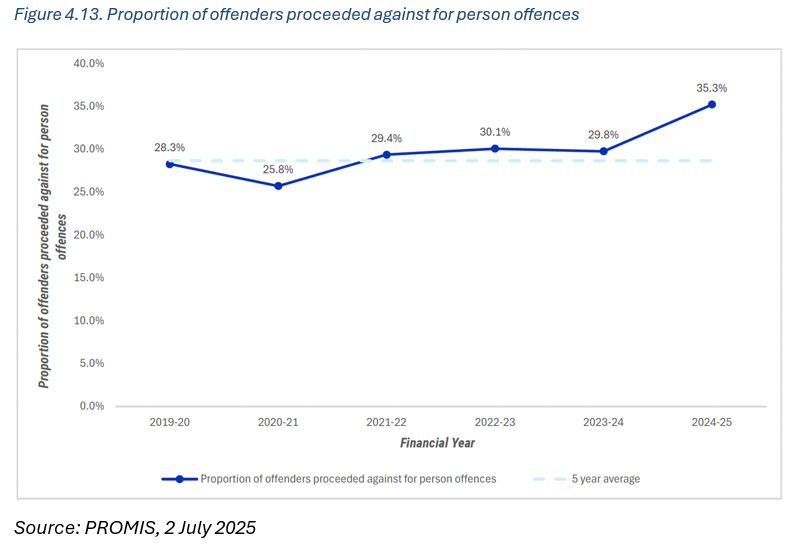
Performance Measure 18 – Proportion of offenders proceeded against for property offences
Date range | Target measure | Actual target | Result | % variation from target | On target |
1 July 2024 to 30 June 2025 | 5-year average or more | 7.8% | 9.3% | 1.5% | Y |
The proportion of offenders proceeded against for property offences was 9.3 per cent. This was
1.5 per cent more than the target of 7.8 per cent, which was the average over the past five years.
Figure 4.14. Proportion of offenders proceeded against for property offences
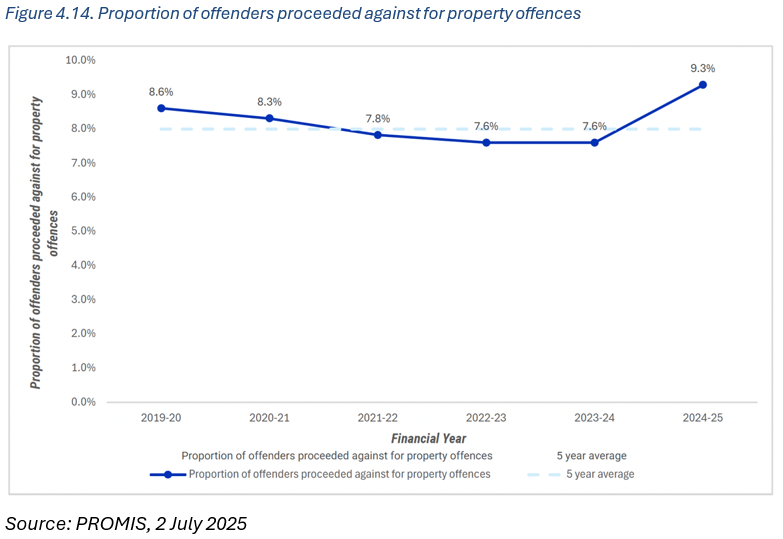
Offenders proceeded against for property offences measures the number of offences where there was an outcome during the reporting period. These outcomes include but are not limited to the apprehension of an offender through an arrest or some other form of proceeding such as a summons or a formal caution, withdrawal of the complaint or the determination that the offence was unsubstantiated. It is important to note that proceedings for an offence may not necessarily occur in the same period in which it was reported.
ACT Policing continues to work with the ACT Government to develop and implement strategies to improve the criminal justice system. This includes the establishment of the Community Policing Proactive Intervention and Disruption Team to focus on reducing recidivism and calls for service.
Outcome: Community Confidence
Performance Measure 19 – Percentage of the community satisfied in general with services provided by police
Date range | Target measure | Actual target | Result | % variation from target | On target |
1 July 2024 to 30 June 2025 | National average or more | 58.2% or more | 64.6% | N/A | N/A |
The percentage of the community satisfied in general with services provided by police in 2024–25 was 64.6 per cent, which was 7.3 per cent above the national average. However as the national average cannot be used as a reliable comparison there is no valid target for this measure.
Performance Measure 20 – Percentage of the community who have confidence in police
Date range | Target measure | Actual target | Result | % variation from target | On target |
1 July 2024 to 30 June 2025 | National average or more | 64.3% or more | 72.2% | N/A | N/A |
The percentage of the community who have confidence in police in 2024–25 was 72.2 per cent, which was 8.4 per cent above the national average. However as the national average cannot be used as a reliable comparison there is no valid target for this measure.
Performance Measure 21 – Number of complaints against police
Date range | Target | Result |
1 July 2024 to 30 June 2025 | Monitor 5-year trend | 107 |
The number of complaints against police in 2024–25 was 107.
Other Reporting
Work undertaken to address key requirements under the new Multiculturalism Act 2023
ACT Policing continues to promote and support multiculturalism in the ACT. The 2024–25 financial year saw a range of activities undertaken in this area and extensive engagement from ACT Policing Multicultural Liaison Officers (MLO) and Community Engagement Team (CET) members including:
- Successful engagement with Canberra Islamic faith leaders resulting in a new fatwa being discussed to support victims of domestic and family violence.
- Delivering presentations on policing awareness and community safety for multicultural seniors’ groups and migrant/refugee students.
- Coordination of community safety meetings between various community groups and ACT Policing Inspectors and Senior Executive members, including the Jewish, African and Hindu communities.
- One-on-one support for Family Violence Safety Action Program and Multicultural Hub clients navigating the ACT legal system.
- Attendance at numerous community events including Multicultural Festival, Eidal Fitr Fair, Women’s Community Iftar dinner, Sri Lankan Festival, Africa Sports Day and Tongan Youth Celebration.
- Collaboration with the Canberra-based AFP Human Exploitation Coordination Officer to develop awareness of human exploitation crime types and referral options amongst the ACT multicultural community.
- The organisation of meetings with vulnerable multicultural community members (via referral or enquiry) to discuss incidents/issues of concern/police processes in neutral environments, using interpreters when appropriate.
- Engaging in conversations with AFP leadership regarding recruitment practices and promoting ACT Policing recruitment among communities to encourage CALD/Culturally and Racially Marginalised community members to consider careers in policing.
- Proactively seeking out educational opportunities for MLO and CET members to increase their knowledge of different cultures to improve their overall cultural literacy.
Translator and interpreter services
The AFP is obligated under the 2022–26 Purchase Agreement to report ACT Policing’s use of translators and interpreters in its Annual Report. In the 2024–25 financial year there were 148 instances where interpreter and translator services were used.
Outcomes achieved aligning with the Ministerial Direction and CPO’s Statement of Intent
Police Services Model
The ACT Government supported ACT Policing to implement the first stage of its strategy to transition to the Police Services Model (PSM). This staged strategy enabled ACT Policing to adapt its operating model and investigative processes to engage and support the community whilst responding to the complexities of modern-day crimes.
The ACT Government supported this policy change by providing $33.9 million and 60 FTE from 2019–20 to 2022–23, through Tranche 1 of the PSM.
As a result of this funding, ACT Policing was able to direct resources where they were most effective, conduct focused crime prevention activities and work across the broader justice system with its partners to ensure the root causes of crime and repeat offending were being addressed.
A broad range of projects with varying degrees of complexity were delivered under the PSM to up to 30 June 2023.
Projects achieved within the first tranche helped to streamline workflows, reduce duplication, meet strategic objectives, reduce costs, and mitigate risks for ACT Policing. Tangible deliverables achieved included the creation of the Proactive Intervention and Diversion Team and increasing reporting capabilities for the community via the online reporting portal. Also, all frontline ACT Policing officers are now personally issued Conducted Energy Weapons. An incredible amount of time has also been placed into research, to ensure ACT Policing continues to adapt and deliver policing services to the standard which the ACT community expects and deserves.
In the 2023–24 Budget the ACT Government funded the More ACT Police (MAP) initiative. This is a commitment by ACT Government to ACT Policing to provide a combined $107.26 million over five years to increase ACT Policing staffing levels by 126 FTE.
To meet future requirements under the Ministerial Direction, Government priorities, and the ACT Policing Strategy, ACT Policing is considering the implementation of an alternative operating model to maximise the use of available resources. This model will identify capability or capacity gaps within ACT Policing and enable service partners to deliver against these gaps. Further, future infrastructure, technology and innovation business cases will be forwarded for ACT Government consideration to address identified capability and capacity gaps.
Proactive Intervention and Diversion Teams
ACT Policing’s Proactive Intervention and Diversion Teams (PIDT) are a visible and proactive presence in the ACT community and focus on operational actions to reduce crime that is placing the community at risk, including the targeting of recidivist offending. In doing so, repeat calls
for service are reduced by intervening, disrupting and preventing crime through focusing on problematic people, places and issues.
Operation TORIC (Targeting of Recidivists in Canberra) is now aligned with PIDT, as the goals are complementary, allowing ACT Policing to meet the expectations of the Canberra community.
The objective of PIDT is to identify, assess and undertake actions targeting recidivist high-harm offenders and crime issues that are placing the community at risk.
Operation TORIC’s focus is on the rapid identification and apprehension of high-risk, high-harm and recidivist offenders who place the community and ACT Policing members at great risk. Evidence shows that swift intervention with these offenders results in a reduction of crimes such as dangerous driving, car thefts, assaults and burglaries.
Due to its success Operation TORIC is now an ongoing Response and Enforcement capability within ACT Policing.
The integrated teams operate under the PIDT portfolio, however they continue to deploy Operation TORIC activities as required. ACT Policing is committed to initiatives that not only reduce repeat call outs and increase diversions (disruption capability) but also support and increase community safety and build community connection.
Reducing the over-representation of First Nations peoples
ACT Policing acknowledges the significant challenge of over-representation of First Nations people in the criminal justice system. ACT Policing works in partnership with the ACT Government, First Nations peoples, non-government organisations and community to develop and deliver programs which better support people who come to the attention of police. ACT Policing provides culturally appropriate support during engagement with police and the justice process through dedicated First Nations Liaison Officers.
The ACT Policing First Nations Liaison Officers and the First Nations Senior Liaison Officer are involved through the Galambany and Warrambul Circle Sentencing when and as required. In line with the National Agreement on Closing the Gap and the ACT Aboriginal and Torres Strait Islander Agreement 2019–28, ACT Policing will continue to focus on equitable access and culturally safe restorative justice, including prevention and diversion programs for First Nations people and communities.
The ACT Aboriginal and Torres Strait Islander Elected Body and the broader First Nations community have informed the development and delivery of the First Nations Cultural Literacy Training Program that is tailored and relevant to the region for ACT Policing’s members. This program fulfils a recommendation of the ACT Ombudsman’s Own Motion Investigation (OMI) concerning ACT Policing’s administrative framework for engagement with the First Nations community.
ETM Perspectives Pty Ltd, a 100% owned Indigenous company, was contracted by ACT Policing to assist in the implementation of the OMI recommendations, including the First Nations Cultural Literacy Training Program and the development of the ACT Policing Strategy for Engagement with First Nations People and Communities. Both the program and the strategy were substantially informed by:
- the community (including First Nations key representative groups and identities), non- government organisations and service providers from the ACT and Wreck Bay
- representatives from ACT Government Directorates and the justice sector, and the ACT Policing workforce.
ACT Policing operates within the strategic framework of the strategy, which is an overarching strategic plan that guides ACT Policing’s engagement with the First Nations people and community.
Through the strategy ACT Policing recognises that mutual respect, trust and partnership between police and First Nations peoples and communities is at the core of achieving the goals and outcomes of the strategy.
The strategy is managed by ACT Policing’s First Nations Working Group which reports to the ACT Policing’s CPO’s Advisory Board. This board aims to strengthen the connection between law enforcement and the First Nations communities, considering strategic issues regarding ACT Policing’s engagement with First Nations peoples in the ACT and providing an avenue for direct community feedback.
Yurwan Ghuda (Strong Children) is an environment-based (on-country) program that sees ACT Policing partner with both the First Nations Justice Unit (FNJU) of the Justice and Community Safety Directorate (JACS) and the ACT Natural Resource Management portfolio of the Environment, Planning & Sustainable Development Directorate to develop and deliver curriculum.
The program seeks to identify at-risk male youth to competently and safely connect them to kin, country and culture through provision of community role models who leverage from lore, to encourage better decision making and behaviours.
ACT Policing is concurrently working with the JACS FNJU and the Wreck Bay Aboriginal Community Council (WBACC) to develop and deliver a youth program like Yurwan Ghuda for female young persons of the Wreck Bay community. This program remains at a formative stage of development.
As a pilot to such a program, during NAIDOC Week in July 2024, ACT Policing and the Canberra Police Community Youth Club (PCYC) scheduled an on-country cultural awareness program for members of the PCYC Project 180 Program.
ACT Policing has supported an application by ACT community not-for-profit service provider Yeddung Mura (Good Pathways) seeking Commonwealth Justice Reinvestment Program funding for First Nations people and communities, with a particular emphasis on young people, adult parolees and their families.
ACT Policing is supporting the current Corrective Services pilot providing alternative, culturally safe reporting sites for eligible Aboriginal and Torres Strait Islander people who are subject to a bail order as an alternative to reporting to a police station.
ACT Policing is currently working with the ACT Government Restorative Justice Unit and FNJU to explore options for restorative justice practices to be introduced in Wreck Bay and Jervis Bay community.
ACT Policing has supported Yerrabi Yurwang Child and Family Aboriginal Corporation with their Yawarj Mara Youth Group. The program is for First Nations male youth aged 10–18 years. A male First Nations Liaison Officer attended the program weekly in 2024–25 and participated in cultural activities such as designing artefacts (spears, clap sticks, message sticks, boomerangs and didgeridoos).
This collaboration is going to expand in 2025–26 to include the Koori Girls Program, which launched in late 2024. It is a similarly themed program for First Nations female youth aged 10–18 years. A female First Nations Liaison Officer will attend sessions throughout the year to assist with building trust and rapport with the young women.
ACT Policing acknowledges there is more to do to improve outcomes for First Nations community and has committed to ongoing engagement to enhance our understanding of and responses to the challenges faced by First Nations people.
The reinvigoration of the Chief Police Officer’s First Nations Advisory Board and seeking to work more closely with the ACT Aboriginal and Torres Strait Islander Elected Body are examples of this outlook.
Engagement with these bodies has not only informed the First Nations Cultural Literacy Training Program and the ACT Policing Strategy for Engagement with First Nations People and
Communities but also influenced the refinement of existing ACT Policing guidelines and practices to better accommodate and support the needs of First Nations people and communities in the ACT.
Implementing effective sexual assault prevention and responses
It is a priority for ACT Policing to implement effective sexual assault prevention and responses. ACT Policing has specialist investigators in the Sexual Assault and Child Abuse Team (SACAT) who investigate matters and guide victim-survivors through each step of the process. SACAT’s primary focus is providing a victim-centric, trauma-informed police response to sexual violence in our community.
ACT Policing works closely with victim support groups such as the Canberra Rape Crisis Centre, the ACT Intermediary Program within the ACT Human Rights Commission and Victim Support ACT to deliver a high-level of support and care to victim-survivors.
ACT Policing acknowledges the Sexual Assault Prevention and Response Steering Committee’s Report into sexual violence and the work that all relevant agencies in the ACT can do to improve the experience for victim-survivors of sexual assault.
ACT Policing continues to review these issues to improve service delivery and support for people who report sexual assault offences. The long-term focus for ACT Policing is to put decision making into the hands of the victim-survivor at the centre of the process so their voice is heard in relation to how their matter proceeds.
On 30 April 2024 the Sexual Assault (Police) Review (the Co-Chairs Report) was publicly released. This report reflects the culmination of work undertaken by the Oversight Committee in response to recommendation 15 of the Listen,Take Action to Prevent, Believe and Heal report which was released in 2021.
The Co-Chairs Report which was informed by an independent researcher, and the ACT Office of the Director of Public Prosecutions (ODPP) investigative case review informed a range of systems, process, governance, and training issues for ACT Policing, and ACT Policing acknowledges its findings. There are 28 recommendations that are now being considered with the ACT Government and partners, to continue to refine ACT Policing processes and systems to ensure that their response to these serious crimes is victim-survivor centred and meets community expectations.
Operation Foster was established in February 2023 in direct response to the ACT ODPP investigative review. The remit of Operation Foster is to reinvestigate matters from the dataset which were deemed as requiring further police action by the ACT ODPP Investigative Case Review. The Operation Foster team conducts investigations with victim survivors who have agreed to reengage with police.
ACT Policing continues to reform the way in which it responds to sexual based offending in line with the recommendations made in the Co-Chairs Report. Most recently this includes internal review of operational practices and a review of training to address feedback provided through the Co-Chairs report.
ACT Policing has reformed its decision-making model to include additional oversight of a Criminal Investigations Management Committee in certain circumstances before investigations are finalised. Part of this committee process considers legal advice where appropriate.
ACT Policing has strengthened ACT Criminal Investigations, adding an additional Crime Manager with specific oversight of the Sexual Offences Child Abuse (SOCA) area. This area incorporates SACAT, the Joint Anti-Child Exploitation Team, Operation Foster and the Child Sex Offender’s Registry elevating the leadership and enhancing the decision-making process.
ACT Policing has redesigned training across all levels to upskill the workforce, mitigate identified issues and improve the outcomes for victim survivors. Training will target police officers working in General Duties in conjunction with specialist members in SOCA and within ACT Criminal Investigations more broadly.
ACT Policing has also introduced direct reporting for victim support agencies to assist victim survivors in coming forward to report to police.
A specialist prosecutor was embedded within the ACT Policing SACAT. This was in addition to an ACT Policing Liaison Officer already based in the ACT ODPP. The specialist prosecutor position was discontinued in December 2024.
Raising the Minimum Age of Criminal Responsibility (MACR)
On 1 July 2025 the ACT’s MACR was raised to 14 years old with exceptions for the following offences:
- murder
- intentionally inflicting grievous bodily harm
- sexual assault in the first degree
- an act of indecency in the first degree.
ACT Policing is committed to initiatives that improve community safety and continues to support the wellbeing of children and young people. To support the MACR reforms, the ACT Government established referral pathways for children under the MACR:
- The Therapeutic Support Panel evaluates the therapeutic needs of the child and advises on appropriate treatment and support. The panel includes an ACT Policing representative.
- Safer Youth Response Service pilot which aims to provide children and young people who are engaging in harmful behaviour with crisis or expedient access to youth workers, emergency accommodation and follow-up case management. Police are currently the only referral pathway and engagement is voluntary.
While ACT Policing continues to support the intent of the MACR reforms and remains focused on diverting youth from the criminal justice system, ACT Policing continues to receive high volumes of complaints about youth behaviour in the ACT.
ACT Policing remains firm on its commitment to continue to respond to any calls for assistance, regardless of the apparent age of the offender. Once officers ensure the safety of all present at an incident, establish the events having taken place and determine whether an offence has occurred, police will then consider the appropriate pathway for any young offenders involved (taking the MACR into account).
ACT Policing continues to monitor and evaluate the outcomes of the MACR reforms. ACT Policing continues to work with ACT Government stakeholders on issues raised in implementing the MACR reforms, including ensuring that police have the appropriate powers when dealing with persons under the MACR and that the MACR referral pathways are providing appropriate and timely support.
Combat dangerous driving
ACT Policing is committed to initiatives that support and increase the safety of all road users on ACT roads. These include joint education campaigns in line with the Road Safety Calendar, focused on improving road culture and driving behaviour. Additional initiatives include Operation TORIC and periodic high-visibility traffic enforcement operations on Canberra’s roads.
Police continue to witness and prosecute dangerous driving incidents that include components of the ‘fatal five’ – impaired driving (alcohol and drug), failing to stop at intersections, excessive
speeding, not wearing a seatbelt and driving while distracted – in addition to deliberately driving on the wrong side of the road and failing to stop for police.
Following a successful evaluation, on 8 May 2024 ACT Policing expanded its online reporting capability to include Dangerous Driving, providing the community with a new mechanism to report bad driver behaviour to police. Importantly, this new functionality allows people to upload digital material of poor driving behaviour.
In 2024–25, 1,816 online Dangerous Driving reports were received by ACT Policing resulting in a total of 1,121 traffic infringement notices and 249 cautions being issued.
In October 2024 the ACT Policing Dangerous Driving Strategy was implemented. Led by ACT Road Policing, front line police from the five police stations across the ACT contributed to months of action targeting specific ‘fatal five’ dangerous driving behaviours.
In November 2024 ACT Policing conducted a month of action to target speeding. This resulted in 685 traffic infringement notices being issued, compared to the October results of 277. During November 2024 there were 11 incidents involving speeds of more than 45kph above the posted speed limit.
In December 2024 ACT Policing conducted a month of action targeting impaired driving. More than 17,500 random breath and drug tests were conducted, resulting in 98 impaired drivers being removed from ACT roads. Throughout the month ACT Road Policing also worked in collaboration with the NSW Police Force and ACT Government vehicle inspections teams on joint border operations.
This collaboration continued into 2025 with a successful joint operation for the Summernats car festival. Throughout the four-day period ACT Road Policing conducted more than 2,00 random breath and drug tests, removing 11 impaired drivers from ACT roads, issuing 198 traffic infringement notices, issuing 91 defect notices and seizing five vehicles.
In January 2025 ACT Policing expanded roadside drug testing to include the detection of cocaine. Throughout that month ACT Policing conducted 488 roadside drug tests; of 45 oral fluid samples analysed, 12 (26.7 per cent) were positive for cocaine.
ACT Policing will continue to increase its presence with a high-visibility approach across the ACT to deter anti-social and dangerous driving and influence safe driving practices. Road Policing continues to promote all aspects of road safety through targeted campaigns in line with the ACT Road Safety Calendar.
Countering terrorism and violent extremism
ACT Policing works with partners across national, state and territory law enforcement agencies to respond to the threat of terrorism and violent extremism.
ACT Policing has a dedicated Countering Violent Extremism (CVE) Case Manager role within the Education and Diversion Team of the Vulnerable Persons portfolio.
The ACT Policing CVE Case Manager partners with JACS to deliver the Commonwealth-funded Living Safe Together Intervention Program (LSTIP), working with individuals and communities vulnerable to radicalisation.
The LSTIP provides support to individuals deemed vulnerable to violent extremism within the ACT community and ensure the ACT Government has the appropriate capability, awareness and training in place to support them. Referrals to the LSTIP emanate from a range of partners and see the ACT LSTIP Intervention Panel engage with ACT Policing and ACT Government partners to assess cases.
The core function of ACT Fixated Threat Assessment Centre (FTAC) (formerly ACT FLAG) is to assess and mitigate the threat of harm posed by persons with demonstrated fixated behaviours and persons vulnerable to engaging in lone-actor, grievance-fuelled violence, where there is suspected or known mental illness or mental disorder influencing behaviours and a pathological grievance, evidence of radicalisation or interest in extremism.
The establishment of ACT FTAC has played a vital role in assessing and providing early intervention to members of the community at risk of fixated behaviour towards Members of the Legislative Assembly and ACT Government officials, or lone-actor, grievance-fuelled violence towards the broader ACT community.
Future priorities for FTAC include continuing education sessions such as those provided to the Legislative Assembly and the ACT Department of Education, ongoing outreach and education to referral services and to continue to increase community visibility of FTAC.
Domestic and family violence
ACT Policing is committed to protecting the safety of the community, working with relevant government and non-government agencies to ensure a collaborative approach to supporting victim-survivors of DFV.
ACT Policing operates within an evidence-led, pro-charge, pro-arrest and presumption against bail framework when responding to DFV. ACT Policing also follows a pro-intervention policy when there is insufficient evidence to commence judicial proceedings.
ACT Policing works collaboratively with agencies and stakeholders throughout the DFV sector. ACT Policing utilises its strong relationships with key sector stakeholders including the Domestic Violence Crisis Service, Canberra Rape Crisis Centre, YWCA, Victim Support ACT and Child Protection Service to ensure victim-survivors are supported. The network between these partner agencies is crucial to maintain a level of service and support from point of reported crisis through to, and during, the arrest and finalisation of any judicial process.
The information shared through partnerships helps to inform comprehensive risk assessments undertaken by police, which are used as a predictive tool to identify high-risk victim-survivors and offenders. Sharing this information also allows police and other agencies to support, implement and mitigate future high-risk behaviour. ACT Policing shares its intelligence resources with community and government agencies lawfully, in a collaborative effort to reduce harm.
Most responses to investigations of DFV incidents in the ACT are conducted by frontline general duties officers based across the five ACT Policing stations.
ACT Policing stood up the Domestic and Family Violence Investigation Unit (DFVIU) in mid-2024. This unit is responsible for investigating high-risk matters. The DFVIU is a specialist unit that provides support and education to frontline police, maintains well developed stakeholder relationships and oversees policy and governance. Initial support occurs during the recruit stage while studying at the AFP College and continues throughout their careers as legislation, information, technology and innovation develops. The DFVIU also facilitates training to members across ACT Policing to ensure the skills and knowledge of frontline police is contemporary and aligned with community expectations.
ACT Policing is committed to ensuring that frontline members have the contemporary knowledge to ensure the safety of victim-survivors and hold offenders accountable for their actions.
The DFVIU also supports complex DFV investigations involving high-risk victim-survivors and offenders by regularly attending court to assist with bail oppositions, Special Interim court or police-initiated Family Violence Orders, and work closely with ACT Policing’s Victim Liaison Officers to support DFV survivors. The DFVIU also works with ACT Corrective Services and Child Protection with recidivist and prevention programs.
ACT Policing recognises that women and children are disproportionately affected by DFV. ACT Policing continues to work closely with relevant support services to mitigate the trauma experienced by victim-survivors to ensure that they are supported and protected.
The DFVIU targets high-risk perpetrators and works closely with the Family Violence Safety Action Program in target development and whole-of-sector approaches to ensure victim-survivor safety and that perpetrators are being held accountable.
Between 14 August 2024 and 30 June 2025 the DFVIU laid 163 charges related to DFV incidents.
Strengthening community to prevent exploitation by organised crime
ACT Policing will continue to work collaboratively with partner agencies to coordinate targeting efforts against Outlaw Motorcycle Gangs (OMCGs) and other organised crime groups in the ACT and across Australia. This is being achieved through a number of investigative strategies and initiatives.
ACT Policing works closely with interstate policing partners, law enforcement, intelligence agencies and other stakeholders across the country and internationally through AFP networks, to maximise its impact on organised crime and illicit profit-making enterprises. ACT Policing continues to work with the ACT Government to identify appropriate legislative mechanisms to target serious and organised crime groups.
ACT Policing continues to work to prevent and disrupt serious and organised crime targeting our community. This is being achieved through a number of investigative strategies and initiatives.
Case study: Community Protection Medal – 2025 Recipients
The Community Protection Medal recognises members of police and emergency services who have demonstrated sustained, distinguished and/ or outstanding service to the ACT community. It was established in 2002
and each year the medals are awarded by the Minister for Police, Fire and Emergency Services during a formal ceremony that celebrates the dedication and excellence of ACT’s emergency service staff and volunteers.
In 2025 the ACT Policing recipient was Detective Sergeant Lauren Gilliland (pictured below) honoured with the Community Protection Medal for her exceptional service over the past 15 years. Detective Sergeant Gilliland’s contributions have significantly transformed the way sexual offences and child abuse investigations are conducted in the ACT. Her development of contemporary training programs, now recognised internationally as best practice, has enhanced the capability of ACT Policing and positively impacted countless victims in the ACT.
Detective Sergeant Gilliland began her career as a professional member of ACT Policing in 2006 at the age of 19, working in Communications answering Triple-Zero (000) calls. After graduating from the AFP College she served in general duties at Belconnen Police Station, the Territory Targeting Team in the City, and in criminal investigations with a focus on outlaw motorcycle gangs.
Her selection to help lead the implementation of recommendations from the Sexual Assault Prevention and Response Inquiry marked a pivotal moment in her career.
Over two years she developed a training program that helps officers understand the psychological dynamics of both perpetrators and victims in sexual assault and child abuse cases. This program has since attracted national and international attention.
Detective Sergeant Gilliland is widely respected as a police officer, instructor, mentor and role model, and her work continues to shape the future of policing in the ACT.
Other 2025 recipients of the Community Protection Medal include:
- Michael Caldwell – ACT Ambulance Service
- Commander Guy Cassis – ACT Fire and Rescue
- Colin Dawes – ACT Emergency Services Agency
- Commander Adam Hartnett – ACT State Emergency Service
- Nicola Lewis – ACT Rural Fire Service
ACT Policing congratulates all recipients for their outstanding contributions in service to the ACT community.
Case study: Online Reporting Enhancements
ACT Policing’s Online Reporting Portal was launched in June 2023 to allow the community to report non-urgent, minor property damage and vandalism incidents via a new online form.
This capability continues to expand each year, with the option to report dangerous driving via the portal introduced in 2024 and expanded in 2025 to include theft and lost property reporting. By the end of June 2025 police had received more than 3,600 online reports.
Since July 2024 police have issued more than 1,000 fines totalling more than $500,000 for driving offences after receiving dash-cam or mobile phone footage of dangerous driving from the community.
Between July 2024 and June 2025 police received more than 1,800 reports for dangerous driving and issued more than 1,100 traffic infringement notices. Almost 250 cautions were also issued to drivers.
The most common infringement was traffic light offences, followed by driving without due care, plus negligent driving and overtaking offences.
The third expansion of the ACT Policing Online Reporting – the ability to report theft and lost property – was launched on 14 May 2025.
This expanded capability allows incidents such as retail theft (for example, the theft of clothes or alcohol from a retail outlet) and personal theft (for example, the theft of tools from the tray of a vehicle or a bike theft) to be reported online as well as lost property such as mobile phones or wallets.
Within the first three weeks of the launch of the third expansion 181 theft reports and 61 lost property reports were submitted.
Since the launch, weekly statistics indicate a steady rise in the proportion of reports submitted online relative to the total number of reports received by ACT Policing for that report type. This reflects an ongoing increase in the use of online reporting.
Additional forms available on the portal include reporting of historic sexual assaults, property damage, petrol drive-offs and the ability to report information about crime to Crime Stoppers.
This initiative is led by the ACT Policing Futures team, which is committed to equipping the community with advanced technologies and robust support to ensure appropriate service responses to issues of concern. In collaboration with the ACT Policing Communications team, which is responsible for receiving reports, these efforts are dedicated to providing the community – particularly victims of crime – with the necessary resources and assistance to facilitate reporting and promote safety and confidence throughout the process.
Case study: Operation Minlaton – Disrupting High-Harm Youth Crime
In early February 2025 ACT Policing’s Proactive Intervention and Diversion Team launched Operation Minlaton in response to a sharp escalation in aggravated burglaries and motor vehicle thefts across the ACT.
The operation brought together teams across ACT Policing and the AFP to investigate and disrupt a series of linked incidents committed primarily by young people, with the aim of identifying offenders, preventing further harm.
Between 1 February and 6 March 2025 ACT Policing identified more than 70 incidents connected to the same group of 16 offenders including more than 35 residential burglaries and the theft of vehicles.
The offences had a significant operational and community impact, with the offenders posing an ongoing risk to public safety. The suspected offenders, aged between 14 and 17 years, and one adult aged 20, typically entered homes via unlocked doors, stole car keys and fled in high-end vehicles.
The crimes were often committed in groups and displayed a clear modus operandi: opportunistic, fast and high-risk with little regard for community safety or the outcomes they faced if caught.
Thanks to the hard work and diligence of the officers supporting the operation, by 28 February 2025 seven teenagers, all of whom were repeat offenders, were arrested and charged with a range of serious offences including joint commission aggravated burglary, driving a stolen motor vehicle, driving offences and failing to stop for police.
While key arrests had been made Operation Minlaton remained ongoing, with investigators continuing to monitor and disrupt youth crime patterns. Throughout March and April 2025 targeted disruption activity occurred to deter further offending and highlight police attention on the remaining offenders.
So far eight young people have been charged in connection with these crimes. All but one have pleaded guilty with the court process ongoing as their sentences are finalised.
The outcomes and community safety messages relating to Operation Minlaton were widely publicised across media platforms. Canberrans were urged to take simple but effective steps to protect their homes and vehicles, specifically reminding residents to lock their doors and secure car keys. This proactive engagement helped raise public awareness and encouraged community vigilance.
The community was also informed about the swift police response and the arrest of the offenders, highlighting ACT Policing’s commitment to tackling property crime and holding offenders to account.
Operation Minlaton’s success was due in large part to the collaboration across multiple portfolios, including ACT Policing General Duties from all stations, Communications, Intelligence, AFP Forensics, Forensics Intelligence, and Specialist Operations. This multi- discipline approach enabled timely information sharing, enhanced risk management and improved intervention strategies for repeat youth offenders ultimately leading to positive outcomes for the Canberra community.
5. Professional Standards
- AFP Professional Standards Framework and AFP Conduct Issues
- ACT Policing Complaint Statistics
- Trends Analysis
The term ‘professional standards’ relates to the Commissioner’s expectation that all AFP appointees, including those in ACT Policing, will serve with integrity.
The AFP Professional Standards (PRS) portfolio sits within the AFP’s Security Command and is responsible for maintaining, promoting and enhancing integrity within the AFP. It does this through:
- a proactive integrity framework incorporating the development and delivery of misconduct and corruption prevention strategies
- complaint management through investigation and resolution of misconduct, practices issues and corruption matters.
The AFP’s professional standards are underpinned by the AFP Core Values and the AFP Code of Conduct. Further information on the AFP Values and the AFP Code of Conduct is available on the AFP website (www.afp.gov.au).
AFP Professional Standards Framework and AFP Conduct Issues
PRS is responsible for the development and maintenance of a robust and transparent framework to safeguard and strengthen the integrity of the AFP. It operates under Part V of the Australian Federal Police Act 1979(Cth) (AFP Act) to support the agency and its appointees through the AFP’s Integrity Framework, via a range of strategies to prevent, detect, respond to and investigate corruption, conduct and practices issues.
Integrated Complaints Management Model
In 2022–23 the AFP enhanced the complaints framework by introducing a single entry point for reporting workplace issue and complaints. The model reduces complexity, enhances
communication and timeliness and promotes transparency and consistency in decision making.
The Workplace Issues and Complaints Resolution Team (Resolution Team) launched on
1 March 2023 and consists of a network of contact officers, case managers and administrative investigators who work in partnership with PRS, the Confidant Network and Safe Reporting, SHIELD and AFP business areas, to ensure a supportive complaints resolution process for our people.
The Resolution Team supports members to navigate the grievance and complaints process, and identifies other alternative resolution processes if more appropriate. A dedicated team was established to investigate Category 1 and Category 2 complaints.
The Resolution Team manages external complaints and has extensive engagement and collaboration with external partners, including Victim Support ACT, the Australian Human Rights Commission and the Commonwealth Ombudsman.
Categories of conduct
Part V of the AFP Act defines the categories of complaints relating to AFP appointees. Complaints are dealt with as breaches of the AFP Code of Conduct and fall into four categories:
- Category 1 – relating to minor management issues, customer service and performance matters.
- Category 2 – relating to minor misconduct and inappropriate behaviour.
- Category 3 – relating to serious misconduct.
- Category 4 – relating to corruption issues.
The Resolution Team refers serious misconduct and corruption matters (Category 3 and 4 complaints) to AFP PRS for investigation. Category 3 matters are subject to additional oversight and are reported to the Commonwealth Ombudsman.
In 2022–23, Category 4 Corruption issues (defined by the Australian Law Enforcement Integrity Commissioner Act 2006(Cth)) were required to be reported to the Australian Commission for Law Enforcement Integrity (ACLEI). These matters were deemed to be either significant or non- significant corruption and the matter in which they would be investigated was determined by ACLEI:
- ACLEI
- ACLEI with the AFP jointly
- AFP with ACLEI oversight or management
- AFP without ACLEI oversight or management.
As of 1 July 2023 the AFP started reporting to the National Anti-Corruption Commission (NACC) which succeeded ACLEI. AFP is now required to refer corruption matters that fit within the definition of ‘serious and systemic’. All other corruption matters will be investigated by AFP PRS.
ACT Policing Complaint Statistics
Complaint data
All data related to complaints was extracted from the AFP’s SAS Visual Analytics suite, which is a live system updated on a daily basis. This report is reflective of Category 1–4 complaints that relate to members of ACT Policing. The data for this report was extracted and accurate as at
3 July 2025. This data is subject to change as complaints are upgraded, downgraded, merged, allocated and re-opened.
Following a recommendation from the Commonwealth Law Enforcement Ombudsman in a previous Part V Inspection Report, AFP PRS refined its processes. As a result of this change, there was an increase in allegations submitted that are finalised with a finding applied of ‘section 40TF Discretion not to proceed’. This includes complaints where due diligence inquiries are made on receipt of the complaint and it is determined there is no basis for the complaint. Due diligence inquiries may include reviewing body-worn camera footage or CCTV, and conducting systems access audits.
In 2024–25 AFP PRS received 107 complaints relating to ACT Policing, resulting in 306 allegations[1] being recorded.
Table 5.1. Alleged complaints recorded during 2024–25 by source
Source | Total complaints | Percentage % |
Member of the public | 57 | 53% |
Reporting another AFP member | 48 | 45% |
Self-reported | 2 | 2% |
Total | 107 | 100% |
Table 5.2. Alleged conduct allegations recorded during the last four years, by category[2]
All ACT Policing allegations | 2021–22 | 2022–23 | 2023–24 | 2024–25 |
Category 1 | 44 | 44 | 71 | 60 |
Category 2 | 39 | 38 | 29 | 40 |
Category 3 | 30 | 32 | 103 | 192 |
Corruption issues | 14 | 8 | 17 | 14 |
Total | 127 | 122 | 220 | 306 |
The Trend Analysis section highlights that a large portion of these allegations were finalised, pursuant of section 40TF of the AFP Act for not having the merit to warrant an admin investigation.
Non-compliance with Body Worn Camera Governance
As at 3 July 2025 for the 2024–25 financial year, one complaint was received by Professional Standards, concerning the use of, or failure to use, a Body Worn Camera[3] by any ACT Policing officer. This complaint involved the non-compliance or governance breach against mandatory Body Worn Camera use, based on the requirements under the Crime (Surveillance Devices) Act 2010(ACT) or the Crimes (Surveillance Devices) Act 2022(ACT) Body-worn Cameras Guidelines Disallowable Instrument.
Table 5.3. Finalised conduct allegations during 2024–25, by category[4]
All ACT Policing allegations | Established | Not established | Discretion not to proceed[5] |
Category 1 | 3 | 2 | 68 |
Category 2 | 9 | 11 | 23 |
Category 3 | 11 | 30 | 80 |
Corruption issues | 0 | 20 | 3 |
Total | 23 | 63 | 174 |
Table 5.4. Finalised established conduct breaches during 2024–25
Allegations | Number established |
Due Care/Diligence Failure | 4 |
Discourtesy | 3 |
Driving Misconduct | 3 |
Conflict of Interest | 2 |
Inappropriate Behaviour/Conduct | 2 |
CO3 Fail Secure Ammo/Accoutrements | 1 |
CO3 Serious Nature | 1 |
Fail to Comply with Direction | 1 |
False Information/Statement | 1 |
Inappropriate Behaviour/Conduct Serious | 1 |
Information Access | 1 |
Information Misuse | 1 |
Misuse of Authority | 1 |
Prescribed concentration of Alcohol | 1 |
Total | 23 |
Timeliness of complaints
Timeliness benchmarks are applied to Category 1–3 complaints. The benchmarks are:
- 42 days for Category 1 matters (if not informally resolved within ten business days)
- 66 days for Category 2 matters
- 256 days for Category 3 matters
- Corruption issues fall under the National Anti‑Corruption Commission Act2022 and are not subject to a timeliness benchmark.
Table 5.5. Average and median[6] run time of investigated[7] complaints 2024–25[8]
Investigated ACT Policing complaints | Number of complaints | Average run time (days) | Median run time (days) | % within benchmark | % exceeding benchmark |
Category 1 | 1 | 108 | 108 | 0% | 100% |
Category 2 | 8 | 52 | 61 | 75% | 25% |
Category 3 | 21 | 236 | 212 | 67% | 33% |
Corruption issues | 4 | 292 | 176 | Not applicable | Not applicable |
Total | 34 | 195[9] | 107[10] | - | - |
Table 5.6. Complaints on hand[11] as at 3 July 2025
All ongoing ACT Policing complaints | Ongoing complaints | Within benchmark | Exceeding benchmark | 1–30 days over | 31–89 days over | 90 days or more over |
Category 1 | 0 | 0 | 0 | 0 | 0 | 0 |
Category 2 | 6 | 3 | 3 | 0 | 3 | 0 |
Category 3 | 58 | 32 | 26 | 2 | 7 | 17 |
Corruption issues[12] | 21 | Not applicable | Not applicable | Not applicable | Not applicable | Not applicable |
Total | 85 | 35 | 29 | 2 | 10 | 17 |
Table 5.7. Number of informal complaints reported to the Resolution Team 2024–25
Resolution Team complaints | |
Informal complaints reported to the Resolution Team in 2024–25 | 100 |
Table 5.8. Number of victims’ rights-related complaints reported 2024–25
Victims’ rights-related complaints | ||
Number of complaints made to the agency in 2023–24 | 17 | |
Number of written complaints related to each right[13] | 14C Respectful engagement with victims | 9 |
14D Respectful engagement with child victims | 1 | |
14E Contact with victims | 2 | |
14F Victims’ privacy | 0 | |
15(1) Referral of victims to support services | 0 | |
15A Provision of aids or adjustments to victims | 0 | |
15D/18C Tell victims about administration of justice processes | 0 | |
15F Tell victims about victim impact statement | 0 | |
18D/18E Victims may make victims’ rights complaints and justice agencies must deal with them | 2 | |
16A Update victims about status of investigations | 3 | |
Number of times the agency resolved a written complaint | 12 |
Trends Analysis
Alleged complaints and allegations submitted
ACT Policing saw a 15 per cent increase in the total number of complaints submitted relating to ACT Policing members in 2024–25 compared to 2023–24, rising from 93 to 107.
Of those 107 complaints, 39 per cent (or 42 complaints) did not proceed to an investigation and were finalised as Discretion not to proceed, pursuant to section 40TF of the AFP Act.
In 2024–25 just over half of all complaints were submitted by members of the public: 53 per cent (or 57 complaints). This has decreased from 58 per cent in 2023–24.
Self-reported complaints by an ACT Policing member make up a small percentage of all complaints submitted: 2 per cent (two complaints) in 2024–25, compared to 1 per cent (one complaint) in 2023–24.
Category 1 — ACT Policing saw a reduction in the number of Category 1 allegations submitted in 2024–25 compared to 2023–24 (60 compared to 71). Of the 60 Category 1 allegations submitted in 2024–25, 17 proceeded to an investigation. The remaining 43 allegations were finalised as Discretion not to proceed.
Category 2 — ACT Policing saw a 38 per cent increase in the number of Category 2
allegations submitted in 2024–25 compared to 2023–24 (40 compared to 29).
Category 3 — ACT Policing saw an increase in the number of Category 3 allegations submitted in 2024–25 compared to 2023–24 (192 compared to 103). Of the 192 allegations submitted in 2024–25, 74 per cent (or 143 allegations) proceeded to an investigation. The remaining 49 were finalised as Discretion not to proceed. During 2024–25 multiple separate complaints that were submitted involved multiple allegations and/or multiple members.
Corruption issues — ACT Policing saw a slight reduction in the number of Category 4 allegations received in 2024–25 compared to 2023–24 (14 compared to 17).
The most common allegations submitted against ACT Policing members in 2024–25 were:
Category 1
- Inadequate Service – 31 allegations
- Discourtesy – 17 allegations
- Failure to Act – eight allegations
Category 2
- Due Care/Diligence Failure – 16 allegations
- Inappropriate Behaviour/Conduct – seven allegations
- CO3 non-Serious Nature – three allegations
- Fail to Comply with Procedure – three allegations
Category 3
- CO3 Serious Nature – 61 allegations
- Inappropriate Behaviour/Conduct Serious – 30 allegations
- Due Care/Diligence Failure – 23 allegations
Category 4
- Abuse of Office – 14 allegations
Finalised complaints and allegations
In 2024–25 PRS and the Resolution Team finalised 78 complaints consisting of 260 allegations. While the number of complaints finalised decreased by 21 per cent (from 99 complaints in 2023–24), the number of allegations finalised increased by 28 per cent (from 203 allegations in 2023–24).
Of the 78 complaints finalised, 34 complaints proceeded to an investigation. The remaining 44 were not investigated and finalised as Discretion not to proceed.
Of the 34 investigations finalised in 2024–25, four were corruption issues with no investigation benchmark. Of the remaining 30 Category 1–3 investigations 67 per cent (or 20 investigations) were finalised within the investigation benchmark timeframe. This was an increase compared to 2023–24 when 57 per cent of investigations (or 20 out of 35 investigations) were finalised in the benchmark timeframe.
In 2024–25 there were 260 finalised Category 1–4 allegations which resulted in the following findings:
- 9 per cent (23) Established
- 24 per cent (63) Not Established
- 67 per cent (174) Discretion not to proceed
Of the 174 allegations with a finding of Discretion not to proceed, 146 allegations related to complaints that did not proceed to an investigation.
Established matters
In 2024–25 there was a slight decrease in the number of established allegations compared to 2023–24 (23 compared to 27). 11 established allegations were Category 3. Category 3 represented the highest proportion of all established Category 1–4 allegations (48 per cent).
Comparatively, over the last four financial years, Category 2 established allegations were either the highest proportion, or equal to the highest proportion of established allegations.
The most prevalent established allegation type in 2024–25 was Due Care/Diligence Failure (four allegations). In 2023–24 the most prevalent was Information Access (five allegations).
As outlined in the Statement of Intent dated 18 December 2020[14], Commissioner Kershaw set a target of Category 1–4 established Professional Standards breaches to be less than 3.1 per 100 staff members. ACT Policing met this target in 2024–25 , resulting in 2.2 established
Category 1–4 allegations per 100 staff members. The breakdown of established Category 1 and 2 allegations per 100 staff was 1.2 and the breakdown of established Category 3 allegations per 100 staff was 1.1.
To maintain proper oversight and ensure AFP complaint investigations maintain integrity and fairness in practice and process, the Commonwealth Law Enforcement Ombudsman undertakes an annual review of randomly selected complaint investigations. ACT Policing and the AFP work closely with the Commonwealth Law Enforcement Ombudsman to adopt the principles of best practice for complaint management.
6. Use of Force
All AFP members, including those in ACT Policing, are governed by AFP Commissioner’s Order 3 (CO3) in the application of use of force principles. CO3 articulates mandatory compliance requirements in reporting and training.
All police members receive use of force training, during which the principles of communication and conflict de-escalation are emphasised as alternatives to the use of physical force. Police members are required to complete these use of force qualifications annually.
In all cases where members use force that is not a routine use of force the officer must, as soon as practical, submit a use of force report. ‘Use’ is defined with respect to the type of force used, which is as follows:
- Firearm, conducted electrical weapon or chemical agent (OC Spray) or extended range impact weapon:
- drawing
- aiming
- discharging
- Baton:
- raising with the intention to strike or gain compliance
- striking a person
- Shield:
- striking a person with any part of the shield
- Police dog:
- directed intentional deployment at a person with the intention to gain compliance whether or not the police dog bites the subject
- defence of itself, handler or any other person
- Pyrotechnic device:
- discharging the device so that concussive force, light, sound or any combination of these is emitted against another person[15]
- Long-range audio device:
- emitting sound from the device against another person to gain subject control[16]
Routine use of force means the following uses of force performed as part of an AFP appointee’s operational duties:
- compliant escort or restraint holds (including to effect an arrest)
- compliant handcuffing
- compliant search of a person
- force to enter a building, vehicle, vessel or other secured area to search, recover, seize or arrest where there is no application of force against a person.
Routine uses of force or verbal commands which do not involve the application of use of force options are not reportable. The circumstances of each routine use of force incident event must be recorded within the relevant PROMIS case.
All use of force reports are assessed for compliance with CO3 by the officer’s supervisor. When reviewing the report the supervisor must identify, address and report to Professional Standards (PRS) any suspected misconduct issues arising from the reportable use of force incident. Also, the Commonwealth Law Enforcement Ombudsman can, and does, enquire into use of force incidents and is empowered to make recommendations for the ongoing transparency of use of force recording and reporting processes.
The principles of negotiation, communication and de-escalation are always emphasised as being primary considerations before using physical force. Governance and oversight arrangements are in place to assure the community that any use of force is applied appropriately.
Table 6.1. Summary of the number of Use of Force reports submitted by ACT Policing
During 2024–25 the total number of Use of Force reports submitted by ACT Policing decreased 11.0 per cent from 2023–24.
2023–24 | 2024–25 | Percentage Change (%) | |
Baton | 28 | 25 | -10.7% |
Chemical Agent | 142 | 104 | -26.8% |
Conducted Electrical Weapons | 334 | 253 | -24.3% |
Firearm | 94 | 103 | 9.6% |
Handcuffs | 715 | 683 | -4.5% |
Total | 1313 | 1168 | -11.0% |
Ombudsman’s Own Motion Investigation (OMI) regarding the Use of Force by ACT Policing
In 2024 and 2025 ACT Policing transparently and constructively engaged with the ACT Ombudsman in the conduct of the Ombudsman’s Own Motion Investigation regarding the Use of Force by ACT Policing, providing with information and facilitated visits where requested.
ACT Policing acknowledge there are elements within each of the eight recommendations in the report that show where police actions or policies can be improved or enhanced and have committed to addressing those specific areas.
ACT Policing has established additional governance to ensure that matters are identified, assessed and appropriate responses are implemented to address issues regarding training, processes, frameworks and where required, the conduct of ACT Policing members. This includes the Operational Practices Committee that is chaired by the DCPO, which will also take responsibility for implementing the outcomes of the OMI.
7. Staffing Profile
- Average Full-Time Equivalent and Headcount
- ACT Policing Workforce Composition Headcount
- Average Length of Service by Gender
- Separations
- Recruitment
ACT Policing is committed to providing quality and effective policing services to the ACT Community through a modern, agile and highly skilled workforce. In the 2023–24 budget, ACT Policing received $107.26 million to increase ACT Policing staffing levels by 125 Full-Time Equivalent (FTE) over five years. In 2024–25, 22.75 FTE positions were funded under this initiative.
FTE figures are reported as an average over the full financial year and exclude members who are classified ‘inoperative unpaid’ (members who are on leave and not being paid by ACT Policing). The reporting of average FTE provides the most accurate reporting of resourcing across the year.
In line with the 2022–26 Purchase Agreement, ACT Policing’s FTE is supplemented by the enabling services of the AFP. In 2024–25, 270 nominal FTE were purchased to support ACT Policing under the enabling services model. This notional FTE of sworn and professional members represents the services provided by the broader AFP in the delivery of community policing services to the ACT. Examples of such services include the Tactical Response, Forensics and Professional Standards. Reported FTE figures are higher than the reported headcount due to the inclusion of these enabling FTE.
The enabling FTE of 269.86 excludes ACT Policing members conducting Commonwealth-funded duties and SHIELD services, so this is not reflected in any of the reported headcount figures.
As at 30 June 2025 there was a total of 1,041 members within ACT Policing, of which over a third of the total workforce were female (41.40 per cent).
Females represented 32.85 per cent of the 767 sworn members in ACT Policing, an increase of 0.91 from 31.94 per cent in 2023–24.
ACT Policing had 89 police recruits start in 2024–25, of which 29.21 per cent were female.
Of the 1,041 members, 4.42 per cent identify as First Nations peoples. This is an increase of 0.06 per cent since the previous financial year and is reflective of ACT Policing’s continual commitment to increasing First Nations representation in accordance with the AFP Reconciliation Action Plan 2022–24.
Despite a minor decline of 0.43 per cent in the representation of CALD, ACT Policing remains committed to achieving greater workforce diversity that is reflective of the community we serve. Members with a Disability account for 1.44 per cent of the workforce, an increase of 0.37 per cent compared to 2023–24.
Employees aged between 25 and 44 account for 64.93 per cent of ACT Policing’s workforce, with employees aged over 50 accounting for 18.15 per cent of the workforce.
Average Full-Time Equivalent and Headcount
Table 7.1. Average Full Time Equivalent and Headcount in 2024–25
Police | Protective Service Officer (PSO) | Unsworn | Other | Total | |
Average Full Time Equivalent (FTE) for 2024–25 | 722.41 | 4.16 | 258.54 | 269.86[17] | 1,254.97[18] |
Headcount at 30 June 2025 | 767 | 2 | 272 | 1,041 |
Table 7.2. Headcount on 30 June 2025 by gender
Female | Non-Binary | Male | Total | |
Police | 252 | 2 | 513 | 767 |
PSO | 2 | 0 | 0 | 2 |
Unsworn | 177 | 2 | 93 | 272 |
Percentage of workforce (based on headcount) | 41.40% | 0.38% | 58.21% | 100.00% |
ACT Policing Workforce Composition Headcount
Table 7.3. ACT Policing workforce composition headcount on 30 June 2025[19]
Base salary group | Casual | Band 2 | Band 3 | Band 4 | Band 5 | Band 6 | Band 7 | Band 8[20] | Executive level[21] | SES[22] | Total |
Sworn police officer | |||||||||||
Female | 0 | 47 | 111 | 33 | 20 | 18 | 13 | 6 | 2 | 2 | 252 |
Non-Binary | 0 | 0 | 2 | 0 | 0 | 0 | 0 | 0 | 0 | 0 | 2 |
Male | 0 | 86 | 162 | 82 | 68 | 38 | 57 | 12 | 5 | 3 | 513 |
Subtotal | 0 | 133 | 275 | 115 | 88 | 56 | 70 | 18 | 7 | 5 | 767 |
Unsworn staff | |||||||||||
Female | 0 | 0 | 54 | 51 | 21 | 18 | 24 | 6 | 2 | 1 | 177 |
Non-Binary | 0 | 0 | 2 | 0 | 0 | 0 | 0 | 0 | 0 | 0 | 2 |
Male | 3 | 1 | 31 | 24 | 7 | 13 | 8 | 1 | 4 | 1 | 93 |
Subtotal | 3 | 1 | 87 | 75 | 28 | 31 | 32 | 7 | 6 | 2 | 272 |
PSO staff | |||||||||||
Female | 0 | 1 | 0 | 1 | 0 | 0 | 0 | 0 | 0 | 0 | 2 |
Male | 0 | 0 | 0 | 0 | 0 | 0 | 0 | 0 | 0 | 0 | 0 |
Subtotal | 0 | 1 | 0 | 1 | 0 | 0 | 0 | 0 | 0 | 0 | 2 |
Total | 3 | 135 | 362 | 191 | 116 | 87 | 102 | 25 | 13 | 7 | 1,041 |
Table 7.4. Headcount on 30 June 2025 by employment category and gender
Employment category | Female | Non-Binary | Male | Total |
Ongoing full time | 385 | 3 | 594 | 982 |
Ongoing part time | 43 | 1 | 5 | 49 |
Non-Ongoing full time | 3 | 0 | 4 | 7 |
Casual | 0 | 0 | 3 | 3 |
Total | 431 | 4 | 606 | 1,041 |
Table 7.5. Headcount on 30 June 2025 by division/branch
Division/Branch | Headcount |
Office of Chief Police Officer | 5 |
Office of Chief Police Officer | 5 |
Office of Deputy Chief Police Officer | 4 |
Office of Deputy Chief Police Officer | 4 |
Commander Investigations | 359 |
Office of Commander Investigations | 5 |
Criminal Investigations | 123 |
Intelligence | 75 |
Judicial Operations | 102 |
Family Violence & Vulnerable People | 53 |
SAPR 15 Review Team | 1 |
Commander Operations | 505 |
Office of Commander Operations | 3 |
Communications & Emergency Management and Planning | 102 |
North District | 200 |
South District | 131 |
Road Policing & Proactive Policing | 69 |
Corporate Services | 168 |
Executive General Manager Corporate | 4 |
Executive General Manager Strategic Accommodation | 4 |
Communications & Government Relations | 21 |
Financial & Commercial | 30 |
Policing Futures | 10 |
Human Resources | 22 |
Legislation & Governance | 15 |
Inoperative Pool | 62 |
Total | 1,041 |
Table 7.6. Headcount on 30 June 2025 by division/branch and employment type
Division/Branch | Ongoing | Non-Ongoing[23] | Casual[24] | TOTAL |
Office of the Chief Police Officer | 3 | 2 | 0 | 5 |
Office of the Deputy Chief Police Officer | 3 | 1 | 0 | 4 |
Office of Deputy Chief Police Officer | 3 | 1 | 0 | 4 |
Commander Investigations | 355 | 1 | 3 | 359 |
Office of Commander Investigations | 4 | 1 | 0 | 5 |
Criminal Investigations | 123 | 0 | 0 | 123 |
Family Violence & Vulnerable People | 50 | 0 | 3 | 53 |
Intelligence | 75 | 0 | 0 | 75 |
Judicial Operations | 102 | 0 | 0 | 102 |
SAPR 15 Review Team | 1 | 0 | 0 | 1 |
Commander Operations | 504 | 1 | 0 | 505 |
Office of Commander Operations | 2 | 1 | 0 | 3 |
Communications & EM&P | 102 | 0 | 0 | 102 |
North District | 200 | 0 | 0 | 200 |
South District | 131 | 0 | 0 | 131 |
Road Policing and Proactive Policing | 69 | 0 | 0 | 69 |
Executive General Manager – Corporate | 163 | 1 | 0 | 164 |
Executive General Manager Corporate | 3 | 1 | 0 | 4 |
Communications & Government Relations | 21 | 0 | 0 | 21 |
Financial & Commercial | 30 | 0 | 0 | 30 |
Policing Futures | 10 | 0 | 0 | 10 |
Human Resources | 22 | 0 | 0 | 22 |
Legislation & Governance | 15 | 0 | 0 | 15 |
Inoperative Pool | 62 | 0 | 0 | 62 |
Executive General Manager – Strategic Accommodation | 3 | 1 | 0 | 4 |
Total | 1,031 | 7 | 3 | 1,041 |
Table 7.7. Headcount on 30 June 2025 by age group and gender
Age group | Female | Non-Binary | Male | Total |
Under 25 | 33 | 1 | 29 | 63 |
25–29 | 96 | 1 | 100 | 197 |
30–34 | 89 | 2 | 115 | 206 |
35–39 | 49 | 0 | 83 | 132 |
40–44 | 64 | 0 | 77 | 141 |
45–49 | 34 | 0 | 79 | 113 |
50–54 | 32 | 0 | 63 | 95 |
55–59 | 24 | 0 | 38 | 62 |
60+ | 10 | 0 | 22 | 32 |
Total | 431 | 4 | 606 | 1,041 |
Table 7.8. Headcount on 30 June 2025 by diversity[25]
Headcount | Percentage of agency workforce (%) | |
First Nations peoples | 46 | 4.42% |
Culturally and Linguistically Diverse [26] | 166 | 15.95% |
People with Disability | 15 | 1.44% |
Average Length of Service by Gender
Table 7.9. Average length of service by gender
Female | Non-Binary | Male | Combined average | |
Average years of service | 9.07 years | 1.75 years | 10.21 years | 9.71 years |
Separations
Table 7.10. Separations 2024–25[27]
Headcount | |
Police | 32 |
PSO | 0 |
Unsworn | 19 |
Total | 51 |
Recruitment
Table 7.11. Recruitment 2024–25[28]
Headcount | |
Police Recruits | 89 |
PSO | 0 |
Unsworn | 19 |
Total | 108 |
8. Financials
Financial Performance
The following financial information is based on audited financial reports for 2023–24 and 2024–25.
While our fiscal decisions supported a continued strong financial position during 2024–25, increased employee costs associated with accounting leave adjustments have contributed to a deficit of $0.808 million, or a variance against total revenue of 0.34 per cent.
Financial Analysis
Total revenue received by the AFP for the provision of policing services to the ACT was $241.243 million, including base appropriation, resources received free of charge and other revenue. This represented an increase of $13.035 million compared with the previous financial year (2023–24). The increase resulted primarily from additional funding for the following measures:
- ACT Policing Enterprise Agreement – $9.658m
- National Firearms Register program (FFA funds) – $0.369m
- More ACT Policing (MAP) – $3.910m Offset by reduction in:
- Rent duplication – Road Policing Centre Hume – $0.184m
- Total expenses amounted to $242.051 million, which was an increase of $14.175 million compared to 2023–24. The increased expenditure relates to new and additional budget initiatives funded through the ACT Government budget process. The MAP contributed to the increase in Employee Expenses of $4.857 million compared to 2023–24.
- Annual financial statements for the reporting period, accompanied by the Auditor-General’s independent audit report, can be found at Appendix 1: Financial Statements.
Asset Management
Assets Managed
Many of the facilities and infrastructure used by ACT Policing are owned by the ACT Government. Asset management for the facilities and infrastructure is the responsibility of the Justice and Community Safety Directorate (JACS), supported by ACT Policing.
Table 8.1 shows the assets managed by ACT Policing.
Table 8.1. Assets managed by ACT Policing
Asset Type | |
Built property assets | ACT Policing is housed in 11 facilities, seven of which are owned by the ACT Government. Of the four remaining facilities, three are leased by the AFP and one is leased by ACT Government. |
Land | N/A |
Infrastructure (e.g. roads, bridges, traffic signals) | N/A |
Urban parks | N/A |
Other | For more information see AFP and JACS annual reports. |
Asset Maintenance and Update
Separate to facilities, ACT Policing conducted a number of capability asset upgrades and replacements throughout 2024–25. These included CCTV systems and components, software, cargo lift, gym equipment, TASER, LiveScan fingerprinting systems, ANPR vehicle kits, IPTV upgrades and a mobile generator through asset replacement.
Capability replacement, upgrades, repairs and maintenance all support positive outcomes for ACT Policing and the wider community through maintaining high standards of equipment, safety and technical advancement.
Accommodation
In accordance with the Policing Arrangement and the 2022–26 Purchase Agreement, the ACT Government is responsible for the provision of appropriate facilities and associated infrastructure for the provision of policing services by the AFP. The ACT Government provides eight of the 11 sites occupied by ACT Policing, which includes five police stations. ACT Policing employs 1,041 members (headcount) occupying 35,246 square metres as detailed in Table 8.2.
Table 8.2. Asset maintenance
Building name/type | Area occupied (m2) |
Winchester Police Centre | 6,250 |
Belconnen Police Station | 2,800 |
Traffic Operations Centre | 1,600 |
Gungahlin Police Station | 344 |
Tuggeranong Police Station | 2,800 |
Woden Police Station | 2,200 |
City Police Station | 4,200 |
Specialist Response Group Complex (leased) | 1,800 |
Exhibit Management Centre (leased) | 4,028 |
Road Policing Centre Hume (leased) | 7,350 |
Maritime Operations Yarralumla (leased) | 1,874 |
Capital Works
Capital works projects were completed across ACT Policing sites during the reporting period. Details of the completed works are presented in the following tables.
Table 8.3. Completed works projects 2024–25
New Works Project 1 | |
Project | Gungahlin Police Station – new carport and HVAC upgrade |
Description | Installation of new carport and HVAC asset replacement |
Business unit | Gungahlin Police Station |
Estimated completion date | June 2025 |
Original project value | $405,000 |
Current year expenditure | $405,000 |
Prior year expenditure | $0.00 |
Total expenditure to date | $405,000 |
Financially completed | Yes |
Comments | The Gungahlin carport and HVAC upgrade was installed to provide shelter for the carpark and to also provide privacy and improve thermal comforts within the station. |
New Works Project 2 | |
Project | Winchester Police Centre ‘Hut’ Demountable Refurbishment |
Description | Refurbishment of the demountable office space and clinical consulting rooms |
Business unit | Injury Prevention & Management |
Estimated completion date | July 2025 |
Original project value | $234,000 |
Current year expenditure | $234,000 |
Prior year expenditure | $0.00 |
Total expenditure to date | $234,000 |
Financially completed | Yes |
Comments | The refurbishment was to upgrade existing office space and reutilise a CCTV monitoring area into clinical consulting rooms. |
New Works Project 3 | |
Project | Tuggeranong Police Station – New carport |
Description | Installation of new carport |
Business unit | Tuggeranong Police Station |
Estimated completion date | March 2025 |
Original project value | $328,000 |
Current year expenditure | $162,517 |
Prior year expenditure | $165,483 |
Total expenditure to date | $328,000 |
Financially completed | Yes |
Comments | The Tuggeranong carport was installed to provide both shelter to carpark and protection for police vehicles. |
New Works Project 4 | |
Project | Office Workstation Upgrade |
Description | Replacement of office furniture across multiple sites |
Business unit | Multiple sites |
Estimated completion date | December 2025 |
Original project value | $1,020,000 |
Current year expenditure | $779,000 |
Prior year expenditure | $0.00 |
Total expenditure to date | $779,000 |
Financially completed | No |
Comments | The rollout of workstations and minor furniture, including upgrade of cabling and desktop ICT equipment for 250+ work points. |
Government Contracting
As a Commonwealth agency, ACT Policing complies with the Public Governance, Performance and Accountability Act 2013 (Cth). ACT Policing applies the Commonwealth Procurement Rules when procuring property and services, through the Commissioner’s financial instructions.
Government Procurement Policies
Under Commonwealth Procurement Rules, the AFP is required to undertake the following in relation to procurements:
- Publish all open approaches to the market on AusTender.
- Require procurements valued at $80,000 or more to be conducted through open approaches to the market (select tendering and direct sourcing for procurements valued at $80,000 or more are only allowed in limited circumstances).
- Report the details of all awarded procurement contracts and purchases valued at $10,000 or more on AusTender within six weeks of the AFP entering into the arrangement.
The AusTender website can be accessed at www.tenders.gov.au.
Procurement exempted from Quotation and Tender Threshold
ACT Policing operates within the Public Governance, Performance and Accountability Framework. For more details please see the AFP Annual Report (www.afp.gov.au/about-us/governance-and- accountability/annual-report).
Construction Grants and Social Procurement
ACT Policing did not issue any construction grants or engage in any social procurement activities during the 2024–25 reporting period.